

When tenants prepare to leave a rental property, the kitchen is often one of the areas that receives the most attention during the final inspection. Cooking creates a combination of grease, food residue, fingerprints, dust and moisture that can gradually build up on surfaces, even when the kitchen appears reasonably clean during everyday use.
For homeowners, property managers and tenants looking for Vacate Cleaners in Perth, this is why a basic wipe-down is rarely enough. A proper end-of-tenancy clean needs to address the areas where cooking residue accumulates, including the oven, rangehood, splashback, cupboards, benchtops and hard-to-reach edges.
Detailed kitchen degreasing is not simply about making surfaces look shiny. It is about removing accumulated residue and leaving the kitchen in a condition that is clean, hygienic and appropriate for a final property inspection.
For All Buzz Cleaning, a thorough Vacate Cleaning Service should treat the kitchen as a connected cleaning system rather than a collection of surfaces that can be quickly wiped before leaving.
Why Kitchen Degreasing Matters During a Vacate Clean
Kitchen grease behaves differently from ordinary dust or dirt. Cooking oils can become airborne as vapour and settle on nearby surfaces. Over time, repeated exposure creates a thin film that attracts dust and other particles.
The result can be subtle.
A cupboard may look clean from several metres away but feel slightly sticky when touched. The top of a rangehood may have a layer of residue that is difficult to see. Splashbacks can develop dull patches around cooking areas, while the sides of cabinets near the stove may collect years of fine grease deposits.
During a tenancy, these issues can be easy to overlook because the kitchen is being used continuously.
At the end of a tenancy, however, the property is empty and surfaces are more exposed. Empty cupboards, cleared benchtops and removed appliances make accumulated residue easier to notice.
A professional Vacate Clean therefore needs to go beyond visible dust.
The cleaner should identify where cooking activity has created residue and use an appropriate cleaning method for each surface.
Kitchen Deep Cleaning Should Begin With an Assessment
Effective Kitchen Deep Cleaning is not simply a matter of applying a strong degreaser everywhere.
Different materials respond differently to cleaning products and techniques. Painted cabinetry, laminate, stainless steel, glass, stone, ceramic tile and finished timber can each have different care requirements.
Before cleaning begins, the kitchen should be assessed for:
- Heavy grease accumulation
- Food residue
- Burnt-on deposits
- Dust and debris
- Sticky cupboard surfaces
- Appliance buildup
- Splashback marks
- Grime around handles
- Residue around cooking zones
- Debris inside cupboards and drawers
- Build-up around seals and edges
This assessment helps determine where detailed cleaning is needed rather than treating every surface identically.
Experienced cleaners also pay attention to areas that are frequently missed during routine household cleaning. These can include the tops of cabinets, the sides of appliances, the underside of rangehood components and narrow gaps around fixtures.
That attention to detail is particularly important when the property will be assessed after the tenant has moved out.
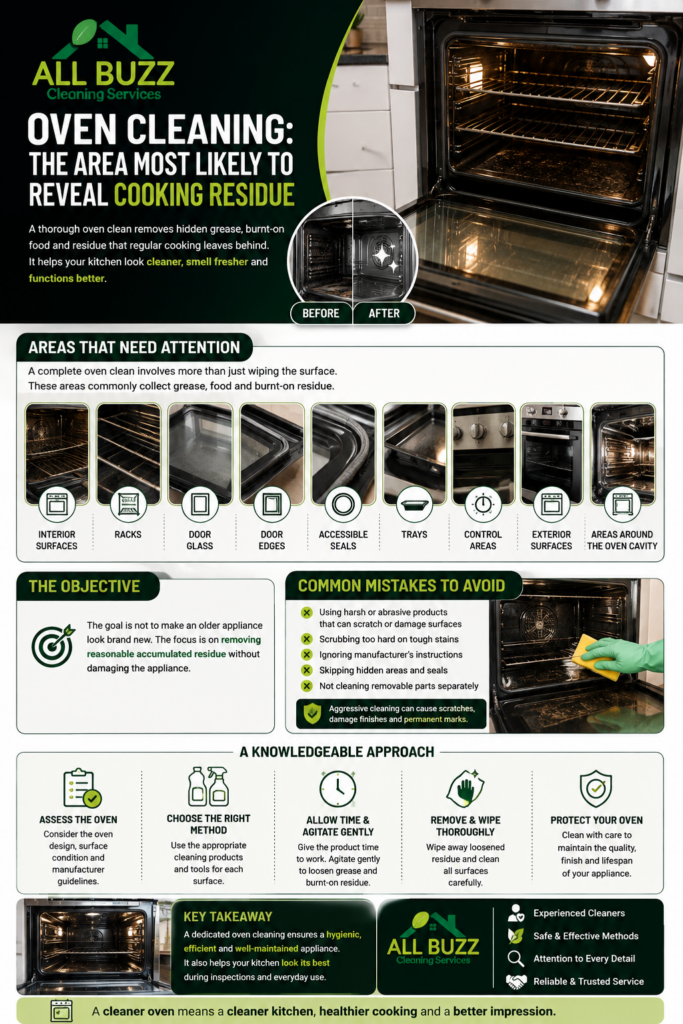
Oven Cleaning: The Area Most Likely to Reveal Cooking Residue
The oven is one of the clearest examples of why a final kitchen clean needs to be thorough.
Regular cooking can leave behind oil, sauce splashes, crumbs and carbonised food particles. When these materials are repeatedly exposed to heat, they can become increasingly difficult to remove.
Oven Cleaning should therefore be approached as a dedicated task rather than an afterthought.
Depending on the oven design and manufacturer’s recommendations, cleaning may involve addressing:
- Interior surfaces
- Racks
- Door glass
- Door edges
- Accessible seals
- Trays
- Control areas
- Exterior surfaces
- Areas around the oven cavity
The objective is not necessarily to make an older appliance look brand new. Cleaning should focus on removing reasonable accumulated residue without damaging the appliance.
One common mistake is using an excessively aggressive product or abrasive material because a deposit appears difficult to remove. That can create scratches, damage finishes or cause permanent marks.
A knowledgeable cleaner considers both the condition of the surface and the appropriate cleaning method.
Rangehood Cleaning and the Problem of Hidden Grease
The rangehood plays an important role in managing cooking vapour, but that means it can also become a collection point for grease.
Over time, the external surfaces may develop a sticky film, while accessible filters and surrounding areas can accumulate cooking residue.
Rangehood Cleaning should therefore form part of a detailed kitchen inspection.
Particular attention may be needed around:
- The underside of the hood
- External surfaces
- Accessible filter areas
- Buttons and controls
- Edges and joins
- Nearby cabinetry
- The wall or splashback surrounding the appliance
The exact cleaning process depends on the rangehood design and manufacturer’s instructions. Filters should not automatically be treated with the same chemicals used on other kitchen surfaces.
The practical lesson is simple: cleaning the visible front of a rangehood while leaving obvious grease underneath does not provide the same result as addressing the appliance comprehensively.
Grease Removal Requires More Than a Quick Wipe
Grease Removal is often where the difference between routine cleaning and professional end-of-tenancy cleaning becomes most apparent.
Fresh cooking splashes can often be removed relatively easily. Older residue is more challenging because repeated exposure can create a bonded film that attracts dust and becomes increasingly stubborn.
The appropriate process may involve:
- Identifying the type of surface
- Selecting a suitable cleaning product
- Applying the product according to its instructions
- Allowing appropriate contact time where required
- Agitating the residue safely
- Removing the loosened material
- Rinsing or wiping the surface appropriately
- Drying and checking the result
The purpose of allowing a suitable product to work is important. Scrubbing harder is not always the answer.
Excessive mechanical force can damage a surface while leaving some residue behind.
Professional cleaning is often about using the right combination of chemistry, contact time, agitation and technique.
Food Residue Removal Goes Beyond the Benchtop
Food Residue Removal is another important part of preparing a kitchen for a final inspection.
Crumbs and food particles can collect inside drawers, cupboard corners, appliance gaps and beneath removable components. These areas may not be obvious when the kitchen is fully stocked with cookware, containers and food.
Once the tenant has moved out, however, empty storage spaces make remaining debris much easier to identify.
A detailed clean should consider:
- Cupboard interiors
- Drawer interiors
- Cabinet corners
- Shelf edges
- Handles
- Kickboards
- Benchtop joins
- Splashback edges
- Appliance gaps
- Floor edges
This is where a methodical approach is more reliable than simply cleaning whatever is easiest to see.
Kitchen Hygiene Is About Residue, Not Just Appearance
Good Kitchen Hygiene involves more than achieving a polished appearance.
Grease and food residue can provide a surface for dust and other contaminants to accumulate. A kitchen that looks acceptable at first glance may still contain residue in high-contact or difficult-to-reach areas.
For a vacating tenant, the goal should be to leave the property clean and free from reasonable accumulated household residue.
For property owners and managers, detailed cleaning can also make the condition of the property easier to assess because surfaces are no longer obscured by dirt and buildup.
This distinction matters.
Cleaning does not repair damaged cabinetry, replace worn appliances or remove permanent stains. A professional cleaner should be transparent about the difference between removable residue and pre-existing deterioration.
The Surfaces That Are Commonly Missed
A kitchen can appear clean while several areas remain untouched.
Some of the most frequently overlooked areas include the tops of cabinets, the sides of appliances and the narrow spaces around handles.
Other commonly missed locations include:
- Cabinet tops
- Cabinet sides
- Drawer runners and edges
- Behind accessible appliances
- Under the rangehood
- Around appliance controls
- Door frames
- Skirting boards
- Corners of splashbacks
- Floor edges
- Vent covers
- Light switches
These areas matter because final inspections tend to be conducted when the property is empty.
A surface that was hidden behind a toaster or small appliance during the tenancy may suddenly become visible.
That is why professional Vacate Cleaners in Perth generally need to think about the kitchen from the perspective of an empty property rather than an occupied household.
Why a Vacate Cleaning Service Should Follow a Consistent Sequence
Cleaning sequence has a practical effect on efficiency and results.
For example, cleaning the floor before wiping dusty cabinetry can create unnecessary rework. Similarly, degreasing surfaces without first removing loose dust and debris can spread grime rather than remove it.
A logical sequence may involve:
Step 1: Remove Loose Debris
Crumbs, dust and loose food particles should be removed before wet cleaning begins.
Step 2: Address Higher Surfaces
Cabinet tops, rangehood areas and other elevated surfaces can be cleaned before lower surfaces.
Step 3: Degrease Cooking Areas
Stubborn cooking residue should be treated using appropriate methods for each surface.
Step 4: Clean Appliances
The oven, rangehood and other relevant appliances can then receive detailed attention.
Step 5: Clean Cupboards and Drawers
Empty storage areas should be checked carefully for crumbs, dust and residue.
Step 6: Finish Benchtops and Fixtures
Once heavier work is completed, visible surfaces can be cleaned and checked.
Step 7: Complete the Floor
The floor should generally be one of the final areas addressed so that it does not immediately collect debris from other cleaning activities.
This sequence reduces duplicated effort and makes it easier to conduct a final quality check.
Common Mistakes Tenants Make Before a Final Inspection
Cleaning Only What Is Visible
A quick wipe across the benchtop and cupboard fronts may create the impression of cleanliness, but it does not address hidden grease and residue.
Ignoring the Oven
The oven is often one of the first appliances to reveal whether a kitchen has received detailed attention.
Forgetting the Rangehood
The underside and surrounding areas can accumulate significant cooking residue.
Using the Same Product Everywhere
A powerful cleaner suitable for one material may damage another. Product selection should be based on the surface being cleaned.
Leaving Cleaning Until Moving Day
Trying to clean an entire property after furniture removal, moving tasks and utility arrangements have already consumed the day often results in rushed work.
Starting earlier gives you time to identify areas that need additional attention.
Practical Tips for Getting Better Results
Before the cleaning process begins, remove personal belongings and food from the kitchen wherever possible. Empty cupboards and drawers provide much better access and make it easier to identify residue.
Allow appliances to cool completely before cleaning them. Check manufacturer guidance where there is uncertainty about suitable cleaning products or removable components.
For stubborn grease, avoid immediately reaching for the strongest available chemical. Start with an appropriate product and method for the surface, then increase the cleaning effort only when necessary.
It is also useful to work systematically from one section to another.
For example, complete one cabinet run, then inspect it under good lighting before moving to the next. This approach makes missed areas easier to identify.
When Professional Kitchen Cleaning Makes Sense
A professional Vacate Cleaning Service can be particularly useful when a property has experienced a long tenancy, frequent cooking, extensive grease buildup or limited time before handover.
Professional cleaning is also practical when the tenant needs to focus on packing, moving furniture, arranging utilities and completing other end-of-tenancy responsibilities.
However, expectations should remain realistic.
A cleaner can remove accumulated dirt, grease and residue where the material is safely removable. They cannot guarantee that permanent stains, damaged surfaces, worn finishes or neglected materials will become new again.
Clear communication about the property’s condition is therefore part of good cleaning practice.
Expert Advice: Think Like a Property Inspector
One of the most useful ways to approach a vacate clean is to stop looking at the kitchen as the person who has lived there.
Instead, imagine entering the property for the first time.
Would you notice grease around the cooking area?
Would the oven interior attract attention?
Would the rangehood look clean from underneath?
Would the inside of the cupboards be free of crumbs?
Would the floor edges and corners appear properly maintained?
This perspective changes the cleaning process.
The objective is not to perform cosmetic cleaning for photographs. It is to restore the property to a clean, presentable condition after everyday household use.
That mindset is particularly valuable for tenants who want to reduce avoidable disputes about cleaning at the end of a tenancy.
Final Thoughts
A kitchen can influence the overall impression of a property more than many tenants expect. Grease around cooking areas, food residue inside storage spaces and neglected appliance surfaces can remain noticeable even when the rest of the property has been cleaned carefully.
That is why detailed degreasing should be considered an essential part of a thorough Vacate Cleaning Service, particularly when the property has experienced years of regular cooking and household use.
For tenants and property owners looking for a practical cleaning approach, All Buzz Cleaning focuses on the details that can be overlooked during a rushed end-of-tenancy clean. The aim is not simply to make a kitchen look tidy, but to address accumulated residue carefully and leave the property in a clean, presentable condition.
A methodical Vacate Clean gives the kitchen the attention it deserves—from Oven Cleaning and Rangehood Cleaning to grease removal, cupboard interiors and final floor cleaning. For All Buzz Cleaning, that detailed approach is what turns an ordinary final clean into a more complete end-of-tenancy preparation.
Frequently Asked Questions
1. Why is kitchen degreasing important in a vacate clean?
Kitchen degreasing is important because cooking oils can gradually create a sticky film on surfaces. This residue may attract dust and become more difficult to remove over time. Areas around cooktops, rangehoods, splashbacks and cabinetry can therefore require more attention than ordinary dusting or wiping. A detailed clean addresses accumulated residue rather than only visible marks.
2. Does oven cleaning form part of a standard vacate cleaning process?
The scope varies between cleaning providers and individual properties, so it is worth confirming what is included before booking. Where oven cleaning is required, the appliance should be assessed separately because burnt-on food, grease and carbonised residue may require additional time and appropriate cleaning methods. The cleaner should also avoid techniques or chemicals that could damage appliance surfaces.
3. How can I remove heavy grease from kitchen cabinets?
The correct method depends on the cabinet material and finish. Begin by checking the manufacturer’s care recommendations where available. Use a suitable cleaner rather than assuming a harsh degreaser is appropriate, and test an inconspicuous area when necessary. Persistent residue may require repeated treatment and gentle agitation rather than aggressive scrubbing, which can damage coatings.
4. What areas of a kitchen are commonly forgotten during a vacate clean?
Commonly overlooked areas include the tops and sides of cabinets, cupboard interiors, drawer edges, rangehood undersides, appliance sides, splashback joins, kickboards, skirting boards and floor edges. These areas become more noticeable once the property has been emptied. A checklist-based approach helps ensure the cleaner does not focus exclusively on large, highly visible surfaces.
5. Should I clean the kitchen myself or hire professional Vacate Cleaners in Perth?
The answer depends on the property’s condition, the available time and your confidence in completing detailed cleaning. A small, lightly used kitchen may be manageable as a DIY task. A property with substantial grease, extensive appliance buildup or a tight handover deadline may benefit from professional assistance. Whichever option you choose, assess the kitchen systematically rather than relying on a quick visual wipe-down.