


Moving out of a rental property can feel like a race against the clock. You have furniture to remove, utilities to organise, keys to return, paperwork to complete and a final property inspection to prepare for. Cleaning can easily become the task that gets pushed to the bottom of the list.
That decision can be more expensive than it first appears.
A property may look reasonably clean during a quick walkthrough but still have built-up grease in the kitchen, soap residue in bathrooms, dust around skirting boards, marks on walls, grime inside cupboards or neglected areas behind appliances. These details can become important when the property is assessed at the end of a tenancy.
This is why End of Lease Cleaning Perth is not simply about making a rental look tidy. It is about preparing the property carefully for its final inspection and reducing avoidable cleaning-related disputes, delays and additional expenses.
Some tenants consider cheap end of lease cleaning Perth options or decide to handle everything themselves to save money. That can work when the property is small, lightly used and the tenant has sufficient time and equipment. However, the cheapest approach at the beginning is not always the cheapest outcome.
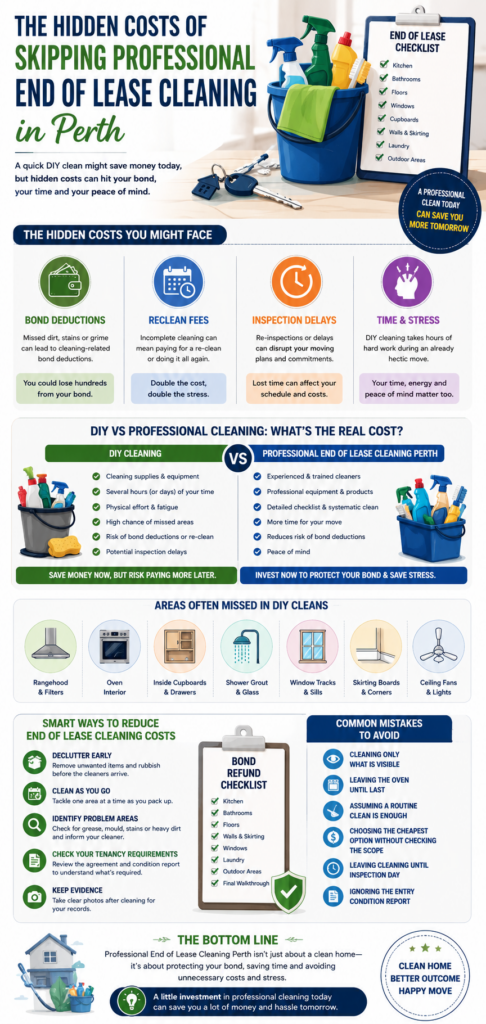
A missed cleaning requirement can potentially contribute to Bond Deductions, additional cleaning charges, Reclean Fees or an Inspection Delay. Understanding these hidden costs can help tenants make a more informed decision before handing back the keys.
Why End of Lease Cleaning Matters in Perth
End-of-tenancy cleaning is different from ordinary weekly or fortnightly household cleaning.
Routine cleaning is designed to maintain a comfortable living environment. End-of-lease cleaning has a different objective: preparing the rental property for handover after the tenancy ends.
That means cleaning needs to be approached systematically rather than simply concentrating on the areas that are most visible.
A tenant might vacuum the floors, wipe kitchen benches and clean the bathroom before leaving. Yet a final inspection can reveal areas such as:
- Inside kitchen cupboards and drawers
- Oven interiors and cooktop surfaces
- Rangehood filters
- Shower screens and bathroom grout
- Skirting boards
- Window tracks
- Door frames and handles
- Light fittings
- Ceiling fans
- Built-up dust on vents
- Marks on walls
- Laundry areas
- Accessible areas behind or beneath appliances
- Outdoor areas where cleaning is part of the tenancy requirements
This is where experienced End of Lease Cleaners Perth can provide practical value. Their approach is generally based on a room-by-room cleaning process rather than a quick surface clean.
Importantly, professional cleaning does not guarantee that a tenant will receive their entire bond. Tenancy outcomes can depend on the property’s condition, the tenancy agreement, fair wear and tear, the entry condition report and other circumstances. Professional cleaning simply helps address the cleaning component thoroughly.
Understanding the Real Cost of Skipping Professional Cleaning
The most obvious reason people skip professional cleaning is cost.
If a tenant receives a cleaning quote, it may seem unnecessary to spend that money when they can clean the property themselves. But the calculation should include more than the initial cleaning price.
Consider the total cost of the DIY approach:
Cleaning supplies + equipment + time + transport + physical effort + missed areas + potential recleaning + possible delays
For someone with several days available and appropriate equipment, DIY cleaning may be perfectly reasonable.
For a tenant who has only one day between moving furniture and returning keys, the situation is different.
A rushed clean often produces inconsistent results. Visible surfaces may look acceptable while detailed areas remain unfinished.
The hidden cost is not necessarily a specific dollar amount. It can be the time, stress and uncertainty created by having to correct cleaning issues at the last minute.
Bond Cleaning Costs: What Tenants Should Actually Consider
Looking Beyond the Initial Quote
When comparing Bond Cleaning Costs, tenants often focus on the cheapest advertised price.
Price matters, but it should not be the only consideration.
A low quote can become less attractive if important areas are excluded, if the cleaner has limited availability, or if the property requires additional work that was not understood before booking.
Before comparing prices, establish exactly what needs to be cleaned.
Ask whether the quoted service covers relevant areas such as:
- Kitchen appliances
- Cupboards and drawers
- Bathrooms
- Floors
- Windows or accessible glass
- Skirting boards
- Doors and frames
- Laundry
- Outdoor areas where applicable
- Internal dusting
- Spot cleaning
The goal is not necessarily to find the most expensive cleaner. It is to find a service that clearly matches the property’s actual cleaning requirements.
The Time Cost of DIY Cleaning
Time has a financial value even when no money changes hands.
Imagine a tenant spends an entire weekend cleaning after already working a full week and moving house. They may save the professional cleaning fee, but they lose valuable time during an already stressful period.
There is also a difference between cleaning for appearance and cleaning systematically.
An experienced cleaner is more likely to remember less-obvious areas because they follow a repeatable process.
For a tenant, remembering every detail while managing a move can be much harder.
Equipment and Cleaning Products
Professional end-of-lease cleaning can also involve equipment that tenants may not already have.
Depending on the property and its condition, effective cleaning may require:
- Appropriate floor-cleaning equipment
- Degreasers
- Bathroom cleaning products
- Glass-cleaning equipment
- Microfibre cloths
- Brushes for detailed cleaning
- Extension tools
- Vacuum attachments
- Specialist products for particular surfaces
Buying several products for a single move-out can reduce the apparent savings from doing the work independently.
Bond Deductions: Why Cleaning Quality Matters
One of the biggest concerns at the end of a tenancy is the possibility of a bond dispute or deduction.
A tenant should understand that cleaning is only one part of the overall property condition assessment. Normal wear and tear should also be distinguished from damage or neglect, and tenancy rules can vary.
The practical lesson is simple: document the property’s condition and complete the cleaning thoroughly.
Before moving out, compare the property against the entry condition report where available.
Look at the same areas that were documented when the tenancy began.
For example, if the entry report shows a clean oven and the oven is heavily soiled at the end of the tenancy, that difference is more significant than ordinary signs of use.
Similarly, accumulated grime that could have been removed through normal cleaning may be treated differently from permanent deterioration caused by age or ordinary use.
Professional cleaning cannot change the property’s history, but it can reduce the likelihood that avoidable cleaning issues remain at handover.
Reclean Fees: The Cost of Doing the Job Twice
One of the most frustrating outcomes of an incomplete clean is having to clean the property again.
Consider this common scenario.
A tenant spends six hours cleaning before moving out. They believe everything is finished. During the inspection, several areas are identified as requiring further cleaning.
Now the tenant has to:
- Return to the property.
- Find cleaning supplies.
- Spend additional time cleaning.
- Coordinate access.
- Potentially reschedule other moving-related tasks.
- Wait for another inspection or confirmation.
That is effectively paying for the same task twice in time and effort.
Where a tenant has engaged a cleaning company, it is also important to understand the cleaner’s terms regarding any return visit or Reclean Fees. Ask what happens if an area included in the agreed scope requires attention after inspection.
Clear expectations before the job are much better than arguments afterwards.
Inspection Delays Can Create More Stress
Timing is another hidden cost that is easy to overlook.
A rental handover often involves several moving parts: the tenant’s moving schedule, the property manager, final inspection arrangements, cleaners and sometimes incoming occupants.
If cleaning is incomplete, an inspection may need to be revisited or additional cleaning arranged.
An Inspection Delay can become particularly inconvenient when the tenant has already left the area, returned keys or started another commitment.
This is why cleaning should be planned around the actual handover date rather than treated as an afterthought.
A useful approach is to schedule the cleaning early enough to allow for unexpected issues.
If the final inspection is scheduled for Friday afternoon, leaving all cleaning until Friday morning creates unnecessary risk. A small problem such as heavy oven grease or neglected bathroom grout can consume more time than expected.
End of Tenancy Cleaning Perth: What Should Be Prioritised?
When planning End of Tenancy Cleaning Perth, think in terms of inspection visibility and accumulated use.
Kitchen
The kitchen frequently requires more detailed work than tenants initially expect.
Pay particular attention to:
- Oven interior
- Cooktop
- Splashback
- Rangehood
- Cupboard fronts
- Internal cupboards
- Drawers
- Benchtops
- Sink and taps
- Floors
- Walls around cooking areas
Grease is especially important because a kitchen can look clean from a distance while still having a sticky film on surfaces.
Bathrooms
Bathrooms should be checked for:
- Soap residue
- Shower glass
- Taps
- Basins
- Toilets
- Tiles
- Grout
- Mirrors
- Cabinet surfaces
- Floors
- Ventilation areas
A bathroom may be hygienic but still look unfinished if mineral deposits, soap marks or visible buildup remain.
Bedrooms and Living Areas
These areas commonly need:
- Vacuuming
- Mopping where appropriate
- Dusting
- Skirting-board cleaning
- Door and frame cleaning
- Removal of cobwebs
- Spot cleaning of suitable surfaces
- Cleaning around accessible fixtures
Furniture can hide substantial dust. Once the property is empty, those areas become much more visible.
Why “Cheap” Does Not Always Mean Lower Cost
The phrase cheap end of lease cleaning Perth can be attractive to tenants who are trying to control moving expenses.
There is nothing wrong with looking for value.
The problem begins when price becomes the only selection criterion.
A better question is:
“What am I receiving for the price?”
Compare:
- Scope of work
- Number of cleaners
- Estimated duration
- Property size assumptions
- Additional charges
- Equipment included
- Availability
- Cancellation conditions
- Reclean policy
- Areas excluded from the standard service
For example, a very low quote may be based on a standard clean that does not include certain detailed tasks. Another provider may quote more but include a much broader checklist.
The second service may actually offer better value.
Practical Ways to Reduce End-of-Lease Cleaning Expenses
Professional cleaning does not have to mean ignoring your budget.
There are several ways tenants can keep costs under control.
Declutter Before Cleaning
Cleaners work more efficiently when rooms are empty.
Remove unwanted belongings, rubbish and furniture before the cleaning appointment whenever possible.
Clean as You Move Out
Do not wait until the final day to begin everything.
As each room becomes empty, clean it and keep it closed where practical.
Identify Problem Areas Early
Walk through the property before booking a cleaner.
Look for:
- Heavy grease
- Mould or persistent moisture issues
- Excessive dust
- Stains
- Built-up grime
- Pet-related cleaning
- Large amounts of rubbish
- Exterior areas requiring attention
Tell the cleaner about unusual conditions before receiving a final quote.
Check the Tenancy Requirements
Review your tenancy agreement and condition documentation.
Do not assume that every property requires exactly the same cleaning tasks.
The required standard can depend on the property, agreement and applicable tenancy arrangements.
Keep Evidence
Take clear photographs after cleaning.
Photograph kitchens, bathrooms, floors, walls and other important areas.
This does not replace formal tenancy processes, but it creates a useful record of the property’s condition at handover.
Common Mistakes Tenants Make
Mistake 1: Cleaning Only What Is Visible
A quick visual clean can leave cupboards, skirting boards and appliances unfinished.
Mistake 2: Leaving the Oven Until Last
Ovens can require significantly more time than expected, particularly when grease has accumulated over months or years.
Mistake 3: Assuming a Routine Clean Is Enough
End-of-lease cleaning is more detailed than ordinary household maintenance.
Mistake 4: Booking the Cheapest Cleaner Without Checking the Scope
A low headline price does not tell you what is included.
Mistake 5: Leaving Cleaning Until Inspection Day
This removes your margin for correcting unexpected problems.
Mistake 6: Ignoring the Entry Condition Report
The condition at the beginning of the tenancy provides important context when assessing the property’s final condition.
Mistake 7: Confusing Damage With Cleaning
A cleaning service cannot repair every type of damage.
A stain, broken fixture, damaged surface or permanent deterioration may require a different solution from ordinary cleaning.
Expert Tips for a Smoother Perth Rental Handover
Start With a Room-by-Room Inspection
Walk through the property with a checklist rather than relying on memory.
Open cupboards. Look behind doors. Check corners and edges.
Photograph Before and After Cleaning
Take photographs in good lighting and retain them with your tenancy records.
Schedule Cleaning Before the Deadline
Give yourself enough time to respond if something needs additional attention.
Communicate Special Requirements
If the property has pets, heavy cooking residue, large windows, unusual flooring or other special circumstances, explain this before the cleaning begins.
Ask Questions Before Booking
A professional conversation before the appointment can prevent misunderstandings about price and scope.
Ask:
- What is included?
- What is excluded?
- Are cleaning products included?
- Is equipment included?
- Are there additional charges?
- What is the process if an included area requires recleaning?
- How long is the service expected to take?
Good communication is one of the simplest ways to prevent unpleasant surprises.
Is Professional End of Lease Cleaning Always Necessary?
Not necessarily.
DIY cleaning may make sense when:
- The property is small.
- The tenant has several days available.
- The property has been maintained consistently.
- The tenant has suitable equipment.
- There are no major cleaning challenges.
- The tenant is comfortable completing detailed cleaning.
Professional assistance may be more practical when:
- The property is large.
- The tenant has limited time.
- The kitchen requires heavy degreasing.
- Multiple bathrooms need detailed cleaning.
- The tenant is relocating long-distance.
- The property has been occupied for several years.
- The tenant wants a systematic final clean.
The right choice depends on circumstances, not simply on whether professional cleaning is perceived as expensive.
A Better Way to Think About cheap end of lease cleaning Perth
The goal should not be to find the cheapest possible cleaning appointment.
The goal should be to minimise the total cost of moving out.
That includes money, time, stress and the risk of having to repeat work.
For some tenants, doing the cleaning themselves will genuinely be the best option. For others, paying for professional help can be the more economical decision once the complete workload is considered.
The important thing is to make the decision based on the property’s condition, your available time and the actual cleaning requirements.
Final Takeaway
Skipping professional cleaning does not automatically lead to bond problems, and hiring a professional cleaner does not guarantee a particular tenancy outcome. However, leaving detailed cleaning until the last minute can create avoidable costs and stress.
The real value of End of Lease Cleaning Perth lies in preparation: understanding the required standard, identifying problem areas, cleaning systematically, documenting the property’s condition and allowing enough time for corrections.
If you are considering cheap end of lease cleaning Perth, compare the full scope of each option rather than looking only at the advertised price. A service that is clear about inclusions, exclusions and reclean arrangements may provide better overall value than the lowest initial quote.
A successful rental handover is rarely about making the property look perfect for the sake of appearance. It is about returning it in an appropriately clean condition, meeting your responsibilities and avoiding preventable last-minute complications.
Frequently Asked Questions
1. Can skipping professional end-of-lease cleaning affect my bond?
Potentially, but cleaning is only one factor in the final tenancy assessment. Whether a bond deduction is appropriate can depend on the property’s condition, the entry condition report, the tenancy agreement, fair wear and tear and applicable tenancy rules. Professional cleaning cannot guarantee a full bond return, but a thorough clean can help reduce avoidable cleaning-related issues.
2. Is cheap end of lease cleaning Perth always a good option?
Not necessarily. A low price can represent good value if the service covers everything you need. However, some inexpensive quotes may exclude detailed tasks or charge separately for certain requirements. Always compare the cleaning scope, additional charges, equipment, timing and reclean policy before deciding.
3. What areas are most commonly missed during an end-of-tenancy clean?
Less-visible areas are often overlooked. These can include inside cupboards, oven interiors, rangehoods, skirting boards, door frames, window tracks, bathroom grout and areas behind appliances. Emptying the property before cleaning makes these areas easier to identify and access.
4. How can I avoid Reclean Fees or having to clean twice?
Start by confirming exactly what the cleaner includes in the quoted service. Provide details about the property’s size and condition, and mention any unusually dirty areas. After cleaning, conduct your own room-by-room inspection before the formal handover where possible. If a service offers a reclean policy, understand its conditions before booking.
5. Should I clean the property myself or hire End of Lease Cleaners Perth?
It depends on your circumstances. DIY cleaning can be practical for a well-maintained, smaller property when you have sufficient time and suitable equipment. Professional cleaners may be more practical for larger properties, detailed cleaning requirements or tight moving schedules. The best decision is based on total time, workload, cost and the property’s actual condition—not simply the cheapest upfront option.