


August 24, 2026
Why Bathroom Detailing Plays a Major Role in End of Tenancy Inspections
Moving out of a rental property is rarely as simple as packing your belongings and handing back the keys. One of the final—and often most closely noticed—parts of the process is the condition of the bathroom.
Bathrooms can look clean at first glance while still showing soap residue, cloudy shower glass, stained grout, mould growth, water marks, or buildup around fixtures. These details become particularly noticeable when a property manager or landlord compares the property with its original condition report.
For tenants arranging End of Tenancy Cleaning Perth, bathroom detailing deserves more attention than a quick wipe-down. A properly detailed bathroom is not just about making the room look fresh. It is about removing accumulated residue, addressing areas that are easy to overlook, and leaving surfaces in a condition that is consistent with reasonable end-of-tenancy expectations.
This guide explains why bathroom detailing matters during an end-of-lease inspection, what inspectors commonly notice, and how tenants can approach the cleaning process more effectively.
Why Bathrooms Receive So Much Attention During End-of-Lease Inspections
Bathrooms are high-use, moisture-heavy areas. Unlike a bedroom or hallway, they are exposed to water, body oils, cleaning products, mineral deposits, soap, humidity, and organic residue every day.
As a result, relatively small cleaning issues can become visually obvious.
During an inspection, a bathroom may be checked for:
- Soap residue around the shower and bathtub
- Water marks on taps and fixtures
- Cloudiness on shower screens
- Dirt along tile edges
- Discoloured grout
- Mould around silicone seals
- Hair and debris in drains
- Dust around exhaust fans
- Marks on mirrors
- Residue around toilets
- Dirt behind or underneath fixtures
- General odour or signs of poor ventilation
The important point is that cleanliness is often judged by detail rather than by the overall impression alone.
A bathroom can be mostly clean but still appear neglected because a few highly visible areas have been missed.
The Difference Between Cleaning and Detailing
Routine cleaning usually focuses on removing everyday dirt.
Bathroom detailing goes further.
It involves identifying the surfaces and problem areas that accumulate residue over time and cleaning them systematically. For example, wiping a shower screen removes surface moisture and fingerprints, while proper Shower Glass Cleaning may require attention to soap film and mineral deposits that have built up over weeks or months.
This distinction matters during a final inspection because accumulated residue can remain visible even after a basic cleaning routine.
Bathroom Cleaning: What Should Actually Be Covered?
A common mistake is treating the bathroom as a single cleaning task.
Professional-quality Bathroom Cleaning is better approached as a collection of smaller jobs. Each surface has different cleaning requirements, and some areas need more physical attention than others.
A detailed bathroom clean can include:
- Shower walls and screens
- Bathtub surfaces
- Vanity and basin
- Tapware and fixtures
- Toilet and surrounding floor
- Mirrors
- Tiles
- Grout lines
- Doors and handles
- Exhaust fan covers
- Skirting boards
- Floor edges
- Drains
- Storage areas and shelves
The order also matters.
For example, cleaning the floor before removing dust and residue from higher surfaces can create unnecessary rework. An experienced cleaner generally works from higher surfaces downwards and deals with heavier buildup before finishing with floors and touch points.
Soap Scum Removal: Why Small Residue Becomes a Big Problem
Soap scum is one of the most common bathroom-cleaning issues at the end of a tenancy.
It develops when soap or personal-care products combine with minerals, body oils and water. Over time, this can create a dull, sticky or chalky film.
It is particularly common on:
- Shower walls
- Glass screens
- Bathtubs
- Tile surfaces
- Tapware
- Shower fixtures
Fresh soap residue can often be removed relatively easily. Older buildup is different. Repeated layers can become difficult to remove with an ordinary bathroom spray.
How to Approach Soap Scum Removal
The first step is identifying what type of surface is being cleaned.
Glass, ceramic tile, natural stone, stainless steel and painted surfaces should not automatically be treated with the same product. Some aggressive products can damage sensitive finishes or leave permanent marks.
A sensible process is:
- Remove loose debris first.
- Apply an appropriate cleaner for the surface.
- Allow suitable dwell time rather than immediately scrubbing.
- Agitate stubborn residue with a non-damaging tool.
- Rinse thoroughly.
- Dry the surface.
- Inspect it under good lighting.
One practical lesson from end-of-lease cleaning is that drying the surface often reveals problems that were hidden while it was wet.
A shower screen may appear perfectly clean immediately after rinsing, only to show streaks and mineral deposits once dry.
Shower Glass Cleaning: One of the Most Noticeable Details
Shower glass is often one of the first things people notice when they enter a bathroom.
That makes Shower Glass Cleaning particularly important during a final inspection.
Glass can accumulate:
- Soap film
- Hard-water deposits
- Fingerprints
- Shampoo residue
- Water spots
- General mineral buildup
Simply spraying glass cleaner and wiping it with a cloth may improve its appearance, but it does not necessarily remove established mineral deposits.
Why Shower Glass Can Look Dirty Even After Cleaning
Mineral deposits can bond to glass over time. When viewed under bright bathroom lighting, these deposits can create a cloudy or spotted appearance.
This is why an effective cleaning process needs to distinguish between ordinary surface dirt and mineral scale.
Tenants should also avoid using abrasive materials simply because the glass looks difficult to clean. Scratching a glass surface can create a much bigger problem than the original residue.
A safer approach is to use a suitable glass-cleaning method and test unfamiliar products on an inconspicuous area first.
Tile Grout Cleaning: The Detail Inspectors Can Easily See
Tiles themselves may be relatively easy to wipe clean, while grout lines are much more challenging.
Tile Grout Cleaning matters because grout is porous and textured. Dirt, soap residue and moisture can become trapped within its surface.
Grout may gradually become:
- Grey
- Brownish
- Yellowed
- Darkened
- Mould-stained
This does not necessarily mean the entire bathroom is dirty. However, visibly discoloured grout can affect the overall impression of cleanliness.
Cleaning Grout Without Causing Damage
Grout should be cleaned according to the material and condition of the installation.
A practical approach is to:
- Remove loose dirt.
- Use a grout-appropriate cleaning solution.
- Agitate carefully with a suitable brush.
- Avoid unnecessarily aggressive scrubbing.
- Rinse away cleaning residue.
- Allow the area to dry completely.
- Reinspect difficult sections.
It is also important to distinguish between surface dirt and permanent staining.
Not every dark grout line can be restored to its original colour through cleaning. Old staining, damaged grout or deterioration may require maintenance rather than cleaning.
That distinction is important because tenants should not assume that every visible imperfection is automatically removable.
Mould Prevention: Cleaning Is Only Part of the Solution
Bathrooms provide an ideal environment for mould because they combine moisture, warmth and limited airflow.
Mould can commonly appear around:
- Silicone seals
- Shower corners
- Grout lines
- Ceiling areas
- Window frames
- Behind bathroom fixtures
- Areas with persistent condensation
During an end-of-tenancy clean, visible mould should not simply be covered or wiped superficially.
The underlying moisture conditions also need consideration.
Why Ventilation Matters
Poor ventilation allows moisture to remain in the room longer.
Practical Mould Prevention measures include:
- Running the exhaust fan during and after showers.
- Keeping appropriate ventilation available.
- Drying wet surfaces where practical.
- Reporting persistent leaks or water problems.
- Avoiding unnecessary moisture accumulation.
- Keeping shower areas reasonably dry between uses.
For tenants, there is another important consideration: maintenance issues should not be confused with cleaning issues.
If mould is being caused by a leaking pipe, defective exhaust fan, water ingress or another building problem, cleaning alone may not solve it. Such issues should be documented and reported through the appropriate property-management process.
Bathroom Sanitisation: What It Means at End of Tenancy
Bathroom sanitisation is often misunderstood.
Sanitising does not mean simply making everything smell strongly of disinfectant.
A good cleaning process first removes visible soil, residue and organic material. Sanitisation or disinfection, where appropriate for the surface and cleaning objective, is then more effective.
High-touch areas deserve particular attention:
- Toilet flush mechanisms
- Door handles
- Tap handles
- Cabinet handles
- Light switches
- Shower controls
The objective is a clean, hygienic environment—not an overwhelming chemical smell.
Strong fragrance should never be used to conceal poor cleaning.
Why Detail Matters More Than Speed
End-of-lease cleaning can create a temptation to work quickly because tenants are usually dealing with packing, moving, utility changes and inspection deadlines at the same time.
However, rushing the bathroom often produces predictable results.
A quick clean may cover the obvious surfaces while missing:
- The underside of taps
- Shower corners
- Grout edges
- Behind toilet bases
- Cabinet interiors
- Exhaust fan covers
- Floor-wall junctions
- Shower door tracks
- Drain covers
These are precisely the areas that can undermine an otherwise good final clean.
For tenants looking for affordable end of lease cleaning Perth, affordability should not mean reducing the cleaning process to the most visible surfaces. A better approach is to understand what actually requires attention and allocate time accordingly.
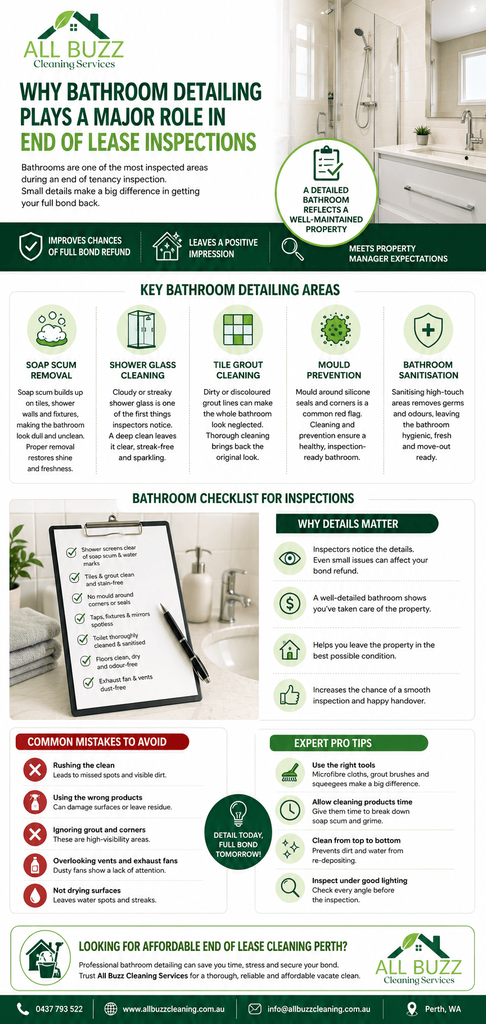
A Practical Bathroom Inspection Checklist
Before an end-of-lease inspection, walk through the bathroom as though you were seeing it for the first time.
Shower Area
Check:
- Is the shower glass clear?
- Are there visible soap deposits?
- Are the corners clean?
- Is the shower track free of buildup?
- Are the fixtures free from water marks?
- Is there mould around silicone or grout?
Vanity and Basin
Inspect:
- Basin surface
- Tap base
- Tap outlets
- Mirror
- Cabinet doors
- Handles
- Interior shelves
- Wall behind the basin
Toilet
Look at:
- Bowl
- Seat
- Hinges
- Exterior surfaces
- Flush button or handle
- Base
- Surrounding floor
- Wall behind the toilet
Floors and Tiles
Check:
- Tile surfaces
- Grout
- Corners
- Skirting
- Hair and debris
- Floor drains
Ventilation
Inspect:
- Exhaust fan cover
- Visible dust
- Ceiling around the exhaust
- Signs of condensation or mould
This final inspection often catches issues that are invisible when cleaning is done room-by-room without a structured checklist.
Common End-of-Lease Bathroom Cleaning Mistakes
1. Cleaning Only at Eye Level
Many tenants clean the surfaces they naturally see and overlook low or high areas.
Better approach: deliberately inspect ceiling corners, skirting, floor edges, fixture bases and cabinet interiors.
2. Assuming a Strong Chemical Equals a Better Clean
A powerful-smelling product does not automatically remove residue.
Better approach: select the cleaning method according to the surface and type of buildup.
3. Ignoring Shower Tracks
Sliding shower-door tracks can collect hair, soap residue and grime.
Because they are narrow, they are easy to overlook.
4. Treating Mould as Ordinary Dirt
Repeatedly wiping visible mould without addressing moisture can lead to recurring problems.
Better approach: clean appropriately while considering ventilation, leaks and moisture sources.
5. Forgetting to Dry Surfaces
Wet surfaces can hide streaks and deposits.
Better approach: dry and inspect glass, taps, tiles and other reflective surfaces before considering the bathroom finished.
6. Expecting Cleaning to Repair Damage
Cleaning cannot fix chipped tiles, deteriorated silicone, damaged grout or permanently etched glass.
This is an important distinction when preparing for an inspection.
Expert Tips for a Better Final Bathroom Clean
Experienced cleaners tend to focus on inspection visibility rather than simply counting how many products or tools they use.
Use Good Lighting
Inspect the bathroom in bright natural or artificial light.
Shower glass and mirrors can look clean under dim lighting while showing significant streaks in brighter conditions.
Work From Dry to Wet and Top to Bottom
Remove dust and loose debris before introducing large amounts of water.
Then work from higher surfaces downward so that falling residue does not contaminate areas already cleaned.
Give Difficult Areas More Time
Soap deposits and mineral buildup often require dwell time and controlled agitation rather than repeated spraying.
Photograph Problem Areas Before Cleaning
If there are pre-existing stains, damaged grout, cracked tiles or deteriorated silicone, photographs can help document their condition.
This is particularly useful where the tenant believes the issue is beyond ordinary cleaning.
Compare With the Original Condition Where Possible
An end-of-lease inspection is generally about the property’s condition rather than achieving an unrealistic “brand-new” appearance.
If you have the original condition report and photographs, reviewing them can help you understand what condition needs to be reasonably addressed.
Perth End of Lease Cleaning: Why Local Conditions Matter
Bathrooms in Perth properties can experience mineral deposits, dust and moisture-related issues depending on the property, water conditions, ventilation and bathroom design.
This means there is no single cleaning routine that works identically for every property.
For example, one bathroom may primarily need soap-film removal, while another may have significant grout discolouration or shower-glass deposits.
This is why Perth End of Lease Cleaning should be approached based on the actual condition of the property rather than a generic list of cleaning products.
The property’s age and materials also matter. Older bathrooms may have ageing silicone, worn grout or fixtures that require gentler treatment.
End of Lease Vacate Clean Perth: A Room-by-Room Mindset
When organising an End of Lease Vacate Clean Perth, it is easy to focus heavily on kitchens, floors and visible living areas.
The bathroom should receive equal attention.
A useful strategy is to treat each bathroom as an inspection zone:
Clean → Dry → Inspect → Correct → Final check
This process is more reliable than simply cleaning everything once and assuming the job is finished.
After the initial clean, step outside the bathroom for a few minutes and return. Look at the shower glass, mirrors, fixtures and floor from different angles.
Small streaks and missed residue often become easier to notice when you deliberately change your viewpoint.
How to Prioritise Bathroom Work When Time Is Limited
If an inspection is approaching and time is limited, prioritise the areas with the greatest visual and practical impact.
Highest Priority
- Shower glass
- Toilet
- Basin and tapware
- Visible mould
- Shower walls and floor
- Grout
- Mirrors
- Floors
Second-Level Details
Then address:
- Cabinet interiors
- Shower tracks
- Exhaust fan covers
- Door frames
- Skirting
- Behind fixtures
- Less visible corners
This does not mean secondary areas should be ignored. It simply creates a logical order when time and energy are limited.
What “Affordable” Should Mean When Choosing Cleaning Help
The phrase affordable end of lease cleaning Perth can mean different things to different tenants.
The lowest quoted price is not necessarily the lowest overall cost.
If important areas are missed and the tenant has to spend another day correcting the work before an inspection, the apparent saving may disappear.
A more useful comparison considers:
- What areas are actually included?
- Is bathroom detailing part of the scope?
- Are shower screens addressed?
- Is grout cleaning included where required?
- Are internal bathroom storage areas covered?
- Are there additional charges for heavily soiled areas?
- Does the cleaner clearly explain what is and is not included?
Transparent scope is more valuable than a vague promise of a “deep clean.”
Final Takeaway
Bathroom detailing can have a disproportionate impact on the overall impression of an end-of-tenancy property. Shower glass, grout, soap residue, fixtures, mould-prone areas and floor edges may seem like minor details individually, but together they determine whether a bathroom looks properly maintained.
The most effective approach is systematic: clean the obvious surfaces, investigate buildup, pay attention to hidden edges, dry reflective surfaces, inspect under good lighting and separate cleaning problems from genuine maintenance issues.
Whether you handle the work yourself or arrange End of Tenancy Cleaning Perth, the goal should not simply be to make the bathroom smell clean for a few hours. The goal is to leave the space thoroughly cleaned, carefully inspected and ready for a fair final assessment.
For tenants seeking affordable end of lease cleaning Perth, the smartest approach is to focus on transparent scope and thorough results rather than simply choosing the cheapest option. A well-detailed bathroom can make a significant difference to the overall presentation of the property at handover.
Frequently Asked Questions
1. Why is bathroom detailing so important during an end-of-tenancy inspection?
Bathrooms accumulate highly visible residue from daily use, including soap film, mineral deposits, mould, water marks and grime around fixtures. Because these surfaces are often reflective or brightly lit, imperfections can stand out quickly during an inspection. Detailed cleaning helps address both obvious dirt and the smaller areas that can make a bathroom appear poorly maintained.
2. Can professional cleaning remove all grout stains?
No. Cleaning can remove surface dirt and some staining, but it cannot guarantee that every discolouration will disappear. Grout can become permanently stained, deteriorated or damaged over time. It is important to distinguish between removable buildup and a maintenance or material-condition issue rather than repeatedly using increasingly aggressive chemicals.
3. How can tenants prevent mould from returning before the final inspection?
The key is moisture management. Use bathroom ventilation appropriately, allow surfaces to dry, address persistent condensation and report leaks or ventilation problems. Cleaning visible mould is only part of the solution if the underlying moisture source remains. Tenants should also avoid assuming that recurring mould is always caused by inadequate cleaning.
4. Is shower glass cleaning really necessary if the bathroom is otherwise clean?
Yes. Shower glass is a large reflective surface, so soap film and mineral deposits can be particularly noticeable. A screen may look acceptable when wet but reveal cloudy patches, streaks or water deposits once completely dry. Inspecting the glass after drying is therefore an important final step.
5. Should tenants clean everything to a brand-new standard?
Not necessarily. The appropriate expectation generally relates to the property’s condition, tenancy use and applicable rental requirements rather than making an older bathroom look newly installed. Cleaning should address accumulated dirt and residue, while genuine damage, deterioration or maintenance issues should be treated separately and documented where appropriate.