

August 31, 2026
Why Property Condition Reports and Professional Cleaning Go Hand in Hand
Moving out of a rental property is rarely as simple as packing your belongings, handing back the keys, and waiting for your bond to be returned. One of the biggest factors affecting a smooth property handover is the condition in which the home is left.
This is where a Property Condition Report becomes particularly important.
A condition report provides a documented record of a property’s state at the beginning and, in many cases, at the end of a tenancy. Cleaning plays a major role because visible dirt, built-up grime, stains, neglected fixtures, and poorly maintained areas can make a property appear significantly different from its documented condition.
For tenants preparing to move, End of Lease Cleaning Perth is therefore not simply about making a home look tidy. It is about restoring the rental to an appropriate standard, addressing areas that are easy to overlook, and making the final inspection easier to assess.
The connection works both ways. A detailed condition report gives tenants a practical reference for what needs attention, while thorough cleaning helps ensure the property’s final condition can be fairly compared with its original state.
This guide explains why these two processes work so closely together, how professional end of lease cleaning Perth can support a smoother property handover, and what tenants, landlords, and property managers should look for before the final inspection.
Understanding the Property Condition Report
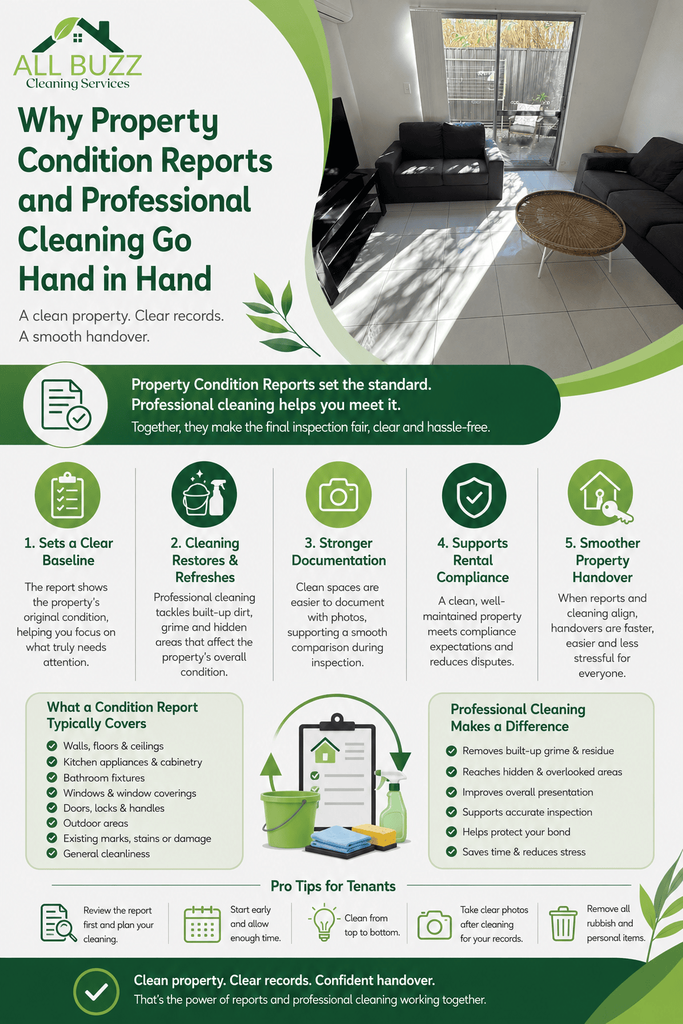
A Property Condition Report is essentially a record of the property’s condition at a particular point in time, commonly when a tenancy begins.
It may document details such as:
- Walls, ceilings, floors and skirting boards
- Carpets and flooring
- Windows and window coverings
- Kitchen appliances and cabinetry
- Bathroom fixtures
- Doors, handles and locks
- Outdoor areas
- Existing marks, stains or damage
- General cleanliness
- Fixtures and fittings
The level of detail can vary depending on the property, tenancy arrangements and documentation used by the property manager.
For tenants, the report is valuable because it establishes a baseline. If a wall already had marks when the tenant moved in, for example, that condition should not simply be treated as new damage at the end of the tenancy.
Cleaning is different from repairing damage, but the two can sometimes appear similar during an inspection. A dusty wall, heavily marked skirting board or stained bathroom surface can make an otherwise well-maintained property look neglected.
That is why reviewing the condition report before cleaning can be extremely useful.
Why Tenants Should Review the Report Before Moving Out
Many people start their final clean by working room by room without checking the original documentation.
That approach can cause problems.
The condition report can reveal details that are easy to forget after living in a property for several years. It may show that:
- The oven was already clean when the tenancy began.
- The shower screens were free from heavy soap residue.
- The carpets were in a particular condition.
- The walls were relatively clean.
- Certain outdoor areas were maintained.
- Particular fixtures were documented as clean or undamaged.
The report should not be treated as a cleaning checklist alone. Instead, use it as a reference point alongside the current condition of the property.
The Connection Between Cleaning and Property Handover
A successful Property Handover depends on more than removing furniture and personal belongings.
The property should be left in a condition that can be reasonably assessed against the relevant tenancy records and expectations.
Cleaning matters because dirt accumulates gradually and is often difficult to notice while someone is living in the property.
Consider a kitchen.
During everyday living, small amounts of grease can accumulate around the cooktop, rangehood, splashback, cabinet handles and oven. Individually, these deposits may seem insignificant. After months or years, however, they can create a visibly different appearance.
The same thing happens in bathrooms.
Soap residue, mineral deposits, dust and moisture can build up around shower screens, taps, grout, exhaust fans and floor edges.
A final clean addresses this accumulated residue and helps return the property to a clean, presentable condition.
This is one reason End of Tenancy Cleaning Perth is often more detailed than an ordinary weekly or fortnightly clean.
Property Condition Report and Final Cleaning: A Practical Comparison
The easiest way to understand the relationship is to think of the condition report as the reference and the final clean as part of the restoration process.
| Area | What the report may document | What final cleaning addresses |
| Kitchen | Existing cleanliness and appliance condition | Grease, food residue, cupboards, oven and surfaces |
| Bathroom | Fixture and surface condition | Soap scum, scale, dust and general grime |
| Floors | Existing marks and flooring condition | Dust, dirt and accumulated surface residue |
| Windows | Cleanliness and visible condition | Glass, frames and accessible tracks |
| Walls | Existing marks or general condition | Dust, cobwebs and removable surface marks |
| Bedrooms | Floor, walls and fittings | Dust, cupboards and accessible surfaces |
| Outdoor areas | General condition | Debris, cobwebs and surface cleaning where applicable |
This comparison does not mean cleaning can fix every discrepancy.
A broken fixture, damaged carpet, chipped tile or permanent stain is a different issue from ordinary dirt. Experienced cleaners understand this distinction and should not promise that every mark or defect can be removed.
Entry & Exit Report: Why the Comparison Matters
An Entry & Exit Report creates an important before-and-after reference.
At the beginning of a tenancy, the entry documentation establishes the property’s condition. At the end, the exit assessment allows the property manager or landlord to compare its condition.
For tenants, this means the final clean should be approached systematically rather than hurriedly.
A useful process is:
- Locate the original entry documentation.
- Walk through the property before cleaning.
- Note areas that have accumulated dirt or grime.
- Separate cleaning tasks from maintenance or repair issues.
- Complete the cleaning.
- Inspect the property again under good lighting.
- Take appropriate final-condition photographs where useful.
- Check that personal belongings and rubbish have been removed.
- Complete the Property Handover process.
This approach is much more reliable than assuming that a property is clean simply because it looks tidy at first glance.
Why Professional Cleaning Can Make the Process Easier
There is a significant difference between general house cleaning and an end-of-tenancy clean.
Routine cleaning is designed to maintain a property’s everyday condition. End-of-lease cleaning is usually a concentrated reset after the tenant has removed furniture, belongings and household items.
Once furniture is gone, previously hidden areas become visible.
You may suddenly notice:
- Dust behind appliances
- Cobwebs in corners
- Marks behind furniture
- Dirt along skirting boards
- Grease underneath kitchen equipment
- Dust inside cupboards
- Accumulated grime around bathroom fixtures
- Debris in window tracks
- Build-up around floor edges
A professional end of lease cleaning Perth service can provide a structured approach to these areas rather than treating the property as an ordinary domestic clean.
The value is not simply speed.
An experienced cleaner knows where end-of-tenancy inspections commonly reveal missed cleaning and can work through the property using a room-by-room checklist.
Inspection Documentation: Creating a Clear Record
Cleaning and documentation work particularly well together because photographs and written records can provide useful evidence of the property’s final condition.
Inspection Documentation may include the condition report, inspection notes, photographs and other tenancy records.
Tenants should avoid assuming that photographs automatically prove everything. Images should be clear, reasonably well lit and accurately represent the condition of the property.
Photographs can be useful for recording:
- Clean kitchen appliances
- Clean bathroom fixtures
- Floors after cleaning
- Empty cupboards
- Clean living spaces
- Outdoor areas
- Any pre-existing issue that remains unchanged
The objective is not to create a huge collection of photographs. It is to maintain a sensible record of the condition in which the property was handed back.
Photographing Before and After Cleaning
If you are documenting the final condition, take photographs after cleaning and after removing personal possessions.
Wide room photographs can establish overall condition, while closer images can document specific areas.
Avoid deliberately hiding defects or using angles that make an area impossible to assess. Accurate documentation is much more useful than overly polished photographs.
Rental Compliance Is Not the Same as Making a Property Look New
One common misconception is that tenants must make a rental property look brand new before moving out.
That is generally an unrealistic standard.
Normal wear and tear is different from damage or accumulated dirt. A carpet that has naturally aged over several years is not necessarily restored to its original condition simply by professional cleaning.
Similarly, cleaning cannot reasonably be expected to reverse:
- Permanent discolouration
- Existing damage
- Age-related deterioration
- Worn finishes
- Broken fixtures
- Structural defects
The practical objective of Rental Compliance is to meet the applicable tenancy requirements and leave the property in an appropriate condition, taking the property’s documented starting condition and ordinary wear and tear into account.
This distinction is particularly important because cleaners should not make legal promises about bond outcomes.
A reputable cleaning provider can clean thoroughly, identify difficult areas and explain limitations. They cannot guarantee that a landlord or property manager will approve the final condition or that a bond will automatically be returned.
A Real-World Example: The Kitchen That Looked Clean
Imagine a tenant who has lived in an apartment for three years.
On moving day, the kitchen appears reasonably clean. The benches have been wiped, dishes are gone and the floors have been vacuumed.
However, during a detailed inspection, the property manager notices:
- Grease around the rangehood
- Residue inside the oven
- Dust on cabinet tops
- Food particles inside drawers
- Marks around handles
- Build-up along the splashback
- Dust underneath accessible appliances
None of these problems necessarily appeared obvious during normal daily living.
A detailed end-of-tenancy clean focuses on these accumulated areas.
This illustrates an important principle: cleanliness should be assessed at inspection level, not just from a quick visual glance.
A Real-World Example: Bathroom Build-Up
Bathrooms provide another common example.
A tenant may clean the shower regularly, but repeated exposure to water, soap and minerals can leave residue on glass, taps and tiles.
After several years, the difference becomes noticeable.
A final clean may involve detailed attention to:
- Shower glass
- Tapware
- Basins
- Toilets
- Tile surfaces
- Grout areas
- Mirrors
- Vanity units
- Exhaust fan covers
- Floor edges
Some mineral staining may be permanent. Some grout discolouration may not be fully reversible. Good cleaning practice recognises these limitations rather than promising unrealistic results.
A Practical End-of-Lease Cleaning Checklist
Before the final inspection, work through each area systematically.
Kitchen
Check:
- Oven interior and exterior
- Cooktop
- Rangehood and filters where appropriate
- Splashback
- Benchtops
- Cabinet fronts
- Accessible cabinet interiors
- Drawers
- Sink and taps
- Appliance surfaces
- Floors
- Skirting boards
Bathrooms
Check:
- Shower screens
- Shower fixtures
- Bath
- Basin
- Tapware
- Toilet
- Vanity
- Mirrors
- Tiles
- Accessible grout
- Exhaust fan cover
- Floor and corners
Bedrooms and Living Areas
Check:
- Floors
- Carpets
- Skirting boards
- Doors
- Handles
- Accessible shelves
- Cupboards
- Window sills
- Cobwebs
- Light fittings where safely accessible
Windows and Glass
Where included and safely accessible, inspect:
- Glass
- Frames
- Sills
- Tracks
- Screens
Do not attempt unsafe external window cleaning without appropriate equipment or access.
Outdoor Areas
Depending on the tenancy and property:
- Remove rubbish
- Clear personal items
- Sweep accessible surfaces
- Remove obvious cobwebs
- Check balconies, patios or garages
- Return outdoor areas to their documented condition as reasonably required
Common Mistakes Tenants Make
1. Cleaning Only What Is Visible
The most obvious surfaces receive attention while edges, corners and concealed areas are forgotten.
Better approach: inspect the property from an inspection perspective rather than a daily-living perspective.
2. Leaving the Oven Until the Last Hour
Oven cleaning can take considerably longer than expected, particularly where grease has accumulated.
Better approach: identify difficult appliances early and allow enough time for detailed cleaning.
3. Ignoring the Condition Report
Without reviewing the original documentation, tenants may spend time worrying about existing conditions while overlooking areas that genuinely need attention.
Better approach: compare the current property with the entry documentation before finalising the cleaning plan.
4. Assuming Cleaning Fixes Damage
Cleaning and repairs are separate responsibilities.
Better approach: identify damage separately and report or address it through the appropriate process.
5. Treating Every Stain as Removable
Some stains are permanent, particularly on porous surfaces, aged grout, carpets or painted materials.
Better approach: ask the cleaner what can realistically be improved before assuming a stain can be completely removed.
6. Rushing the Final Inspection
Moving day is stressful, and tenants sometimes finish cleaning minutes before handing back the keys.
Better approach: finish early enough to conduct a final walk-through in good lighting.
Expert Tips for a Smoother Property Handover
Start With Documentation, Not Cleaning Products
Before doing anything, locate the entry report and any relevant inspection documentation.
This gives you a baseline and helps prioritise the work.
Clean From Top to Bottom
Start with higher surfaces before cleaning floors.
For example:
- Remove cobwebs.
- Dust higher surfaces.
- Clean cupboards and fixtures.
- Clean benches and surfaces.
- Complete bathroom and kitchen detailing.
- Vacuum.
- Mop hard floors last.
This prevents dust and debris from falling onto surfaces you have already cleaned.
Empty the Property Before the Final Detailed Clean
Furniture and belongings hide dirt.
Once rooms are empty, inspect behind and underneath items that have been removed.
Use Adequate Lighting
A room can appear clean under dim lighting but reveal dust, streaks and marks in daylight.
Where possible, inspect the property during daylight.
Separate Cleaning From Maintenance
Create two lists:
Cleaning
- Grease
- Dust
- Soap residue
- Cobwebs
- Dirt
- Surface marks that may be removable
Maintenance/repair
- Broken handles
- Damaged fixtures
- Cracked tiles
- Faulty appliances
- Damaged walls
- Permanent defects
This makes the final process much clearer.
When Should You Consider Professional End of Lease Cleaning?
Professional cleaning can be particularly useful when:
- You have a large property.
- You have limited time before handover.
- The tenancy has lasted several years.
- The property has accumulated significant grime.
- The kitchen requires detailed degreasing.
- Bathrooms have substantial build-up.
- You want a structured cleaning checklist.
- You are managing a move while working or relocating.
- You want an experienced cleaner to identify commonly missed areas.
It is still important to check exactly what the cleaning service includes. Different providers may have different scopes, exclusions and additional charges.
Ask for clarity about appliances, windows, carpets, outdoor areas and any specialised cleaning before booking.
Why End of Tenancy Cleaning Perth Should Be Treated as a Process
A strong final clean is not just a single event.
It is better viewed as a process involving:
Documentation → Inspection → Cleaning → Final Review → Handover
This process reduces the likelihood of overlooking something important.
For example, if the condition report identifies a clean oven at the start of the tenancy, the tenant knows the oven deserves particular attention during the final clean. If the final inspection then identifies remaining grease, the tenant has a clear opportunity to address it before handover where appropriate.
This is where Perth End of Lease Cleaning becomes more than simply removing visible dirt. The goal is to prepare the property systematically for its next inspection and occupancy.
What Landlords and Property Managers Can Learn From This
The relationship between condition reporting and cleaning is not only relevant to tenants.
Landlords and property managers also benefit from clear documentation and realistic cleaning expectations.
A detailed condition report can:
- Establish a reliable baseline.
- Distinguish existing conditions from later changes.
- Make inspections more objective.
- Clarify cleaning expectations.
- Reduce misunderstandings.
- Improve communication during handover.
Clear documentation benefits everyone because it reduces reliance on memory.
The more accurately a property’s condition is recorded at the beginning and end of a tenancy, the easier it is to assess what has actually changed.
Final Thoughts
A Property Condition Report and a thorough final clean serve different purposes, but they work together extremely well.
The condition report establishes the documented baseline. Cleaning helps address accumulated dirt, grime and residue that develop during normal occupancy. Inspection Documentation provides another layer of evidence, while a structured Property Handover process brings everything together.
For tenants, the smartest approach is not to wait until moving day and clean everything as quickly as possible. Review the original condition report, identify priority areas, separate cleaning from repairs, allow enough time for detailed work and conduct a final inspection before handing back the property.
When the job requires additional time, equipment or experience, professional end of lease cleaning Perth can provide a systematic approach to preparing the home for its final inspection.
Ultimately, the goal is straightforward: leave the property clean, documented and ready for a fair, well-organised handover.
Frequently Asked Questions
1. Why is a Property Condition Report important when arranging end-of-lease cleaning?
A Property Condition Report provides a reference point for the property’s documented condition. Reviewing it before cleaning helps tenants identify areas that were clean or well maintained at the beginning of the tenancy and therefore deserve particular attention before handover. It can also help distinguish cleaning issues from pre-existing damage or ordinary wear and tear.
2. Does professional cleaning guarantee a bond refund?
No. Cleaning providers should not guarantee a bond refund because the final outcome depends on the property’s overall condition, tenancy records, applicable requirements and the assessment conducted by the relevant parties. Professional cleaning can help address dirt, grime and accumulated residue, but it cannot guarantee that every inspection issue will be resolved.
3. Is end-of-tenancy cleaning different from normal house cleaning?
Yes. Routine house cleaning focuses on maintaining everyday cleanliness. End-of-tenancy cleaning is generally a more detailed, one-off clean performed after belongings have been removed. It often involves areas that are overlooked during regular cleaning, such as cupboards, skirting boards, appliance interiors, window tracks and accumulated bathroom build-up.
4. What should I do if the property has damage as well as cleaning issues?
Separate the two. Make a list of cleaning tasks and a separate list of maintenance or damage concerns. Cleaning may remove dirt or residue, but it cannot repair a cracked tile, broken fitting or damaged surface. Review your tenancy documentation and use the appropriate reporting or repair process for issues that are not cleaning-related.
5. Should I take photographs after completing my end-of-lease clean?
Clear final-condition photographs can be useful as part of your personal records, particularly after the property has been emptied and cleaned. Photograph rooms and relevant areas in reasonable lighting and avoid misleading angles. Keep the images alongside your tenancy documentation so you have a chronological record of the property’s condition at handover.