

August 26, 2026
Understanding Fair Wear and Tear vs Cleaning Issues During End of Lease Inspections
Moving out of a rental property can be stressful enough without wondering whether a mark on the wall, worn carpet, or dusty cupboard will affect your bond. During an end-of-lease inspection, one of the most important distinctions to understand is the difference between Fair Wear and Tear and damage or cleaning issues that may be the tenant’s responsibility.
This distinction matters because a property does not have to look brand new when a tenancy ends. Normal use naturally leaves signs behind. At the same time, tenants are generally expected to return the property in an appropriate condition, allowing for reasonable wear over the course of the tenancy.
For tenants preparing for End of Tenancy Cleaning Perth, understanding this difference can help you decide what actually needs attention before the final inspection. It can also help prevent unnecessary disputes over cleaning, damage, and bond deductions.
This guide explains how to assess common end-of-lease issues, what to look for in your Property Condition Report, how cleaning fits into Tenant Responsibilities, and where Cleaning Compliance becomes important.
What Is Fair Wear and Tear?
Fair Wear and Tear refers to the gradual deterioration that occurs through ordinary use of a rental property over time.
A rental home is lived in. Floors are walked on, doors are opened and closed, walls may develop minor marks, and fixtures naturally age. These changes do not automatically mean the tenant has caused damage.
For example, a carpet that has become slightly flattened in a frequently used hallway after several years may reflect normal use. Replacing the entire carpet simply because it no longer looks new would not necessarily be reasonable.
The important question is not:
“Does the property look exactly as it did on moving day?”
Instead, consider:
“Has the condition changed because of ordinary use, or because of avoidable damage or neglect?”
This distinction is particularly important during an end-of-tenancy inspection.
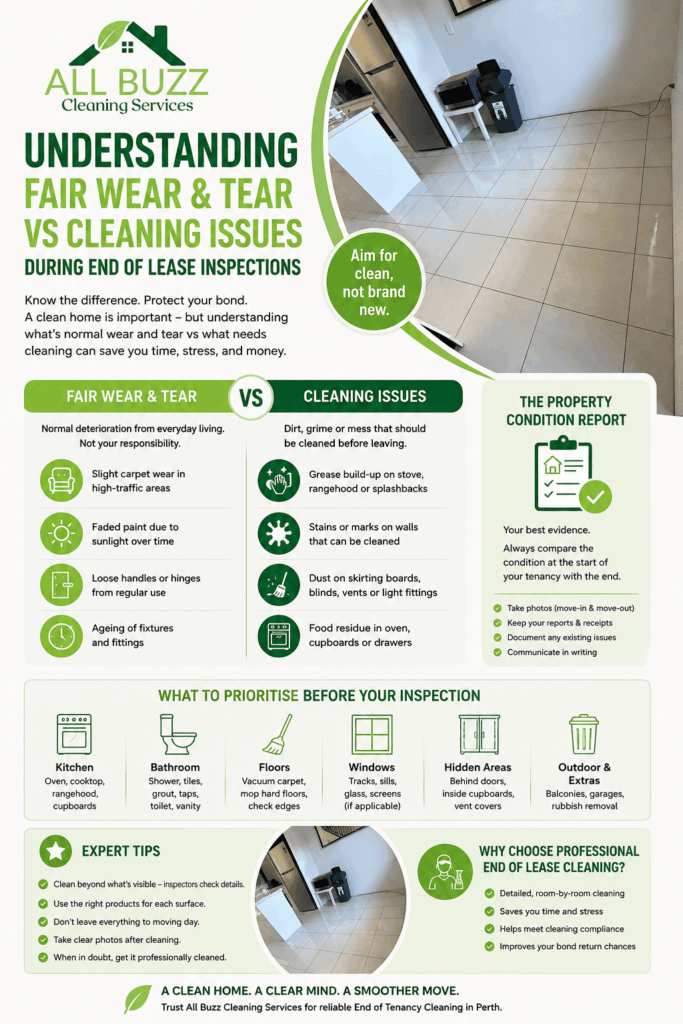
Examples of Fair Wear and Tear
Depending on the age, quality, and original condition of the property, examples may include:
- Minor fading of paint caused by normal exposure to sunlight
- Slight wear on carpet in regularly used areas
- Small scuff marks from ordinary furniture movement
- Gradual deterioration of older fixtures
- Minor loosening of handles or fittings through normal use
- General ageing of appliances and surfaces
The age of the property and length of the tenancy are important factors. A minor mark after a six-month tenancy may be viewed differently from the same mark after several years.
Wear & Tear vs Cleaning: What Is the Difference?
One of the most common sources of confusion during a final inspection is the assumption that anything that looks imperfect must be damage.
That is not necessarily the case.
Wear & Tear vs Cleaning involves two separate questions:
- Has the property physically deteriorated through ordinary use?
- Has the property been left dirty or inadequately cleaned?
These should not be treated as the same issue.
A faded wall is different from a wall covered in removable grime. A permanently worn carpet is different from carpet containing food stains that could reasonably have been removed.
Example: Walls
Suppose a tenant has lived in a property for four years.
The paint has naturally faded and shows slight colour variation around areas exposed to sunlight. That may be consistent with ordinary ageing.
Now consider a different situation. The walls have grease marks, heavy fingerprints, adhesive residue, or removable dirt that was not present at the beginning of the tenancy.
That is more likely to be a cleaning issue rather than ordinary wear.
Example: Kitchen
An older kitchen may naturally show signs of age. Cabinet hinges may become less smooth, laminate may lose some of its original finish, and fixtures may deteriorate.
However, built-up grease on rangehood filters, dirty cupboards, food residue inside an oven, or grime around splashbacks are generally cleaning matters.
The practical lesson is simple:
Ageing is not the same as dirt. Normal use is not the same as neglect.
Why the Property Condition Report Matters
Your Property Condition Report is one of the most useful documents when assessing an end-of-tenancy dispute.
At the beginning of a tenancy, the report records the property’s condition. It may include written descriptions and photographs covering areas such as:
- Walls and ceilings
- Flooring and carpets
- Kitchen surfaces
- Appliances
- Bathrooms
- Windows
- Doors and handles
- Outdoor areas
- Fixtures and fittings
When the tenancy ends, the property’s condition can be compared with that original record.
A Practical Comparison Method
Before the final inspection, work through the property room by room.
For each issue, ask:
What was the condition at the start?
Then ask:
What is the condition now?
Finally:
Is the difference caused by ordinary use, damage, or inadequate cleaning?
For example:
| Issue | Possible Classification |
| Slight carpet flattening in a hallway | Fair Wear and Tear |
| Large burn mark in carpet | Possible damage |
| Dust on skirting boards | Cleaning issue |
| Naturally faded paint | Fair Wear and Tear |
| Large removable crayon marks | Possible cleaning/damage issue |
| Grease inside oven | Cleaning issue |
| Broken cupboard door | Possible damage |
| Minor ageing of older tapware | Fair Wear and Tear |
This comparison is more useful than simply asking whether something “looks old” or “looks bad.”
Tenant Responsibilities at the End of a Tenancy
Understanding Tenant Responsibilities helps remove much of the uncertainty surrounding the final inspection.
Tenants should generally take reasonable steps to leave the rental property in the required condition, subject to applicable tenancy rules and the property’s original condition.
This commonly involves:
- Removing personal belongings
- Removing rubbish
- Cleaning floors
- Cleaning kitchens and appliances
- Cleaning bathrooms and toilets
- Cleaning accessible surfaces
- Addressing excessive grime
- Cleaning windows where required
- Cleaning outdoor areas where applicable
- Returning keys and other provided items
- Reporting relevant damage rather than concealing it
The exact obligations can depend on the tenancy agreement, property condition, circumstances, and applicable Western Australian tenancy requirements.
Tenants should therefore avoid relying solely on generic online checklists. The original condition report and tenancy documentation should be reviewed alongside current requirements.
Cleaning Compliance: Why “Clean” Does Not Mean “Brand New”
Cleaning Compliance is sometimes misunderstood.
A rental property generally does not need to be restored to a better condition than it was in at the beginning of the tenancy simply because the tenant is moving out.
For example, if an oven was already heavily used when the tenancy began, the tenant should not assume they are responsible for restoring it to showroom condition.
At the same time, leaving additional grease, food residue, dust, or accumulated grime may create a legitimate cleaning concern.
The sensible approach is to aim for a condition that is consistent with the property’s original cleanliness, allowing for reasonable deterioration through ordinary use.
A Useful Pre-Inspection Test
Walk through the property in daylight.
Look at:
- Corners
- Behind doors
- Inside cupboards
- Under appliances where accessible
- Window tracks
- Shower screens
- Taps and fixtures
- Oven interiors
- Rangehood filters
- Skirting boards
- Light fittings
- Air vents
These are areas tenants often overlook because they are not part of everyday cleaning.
A final inspection, however, tends to reveal accumulated dirt much more clearly.
Rental Law Basics for End-of-Lease Inspections
Understanding basic tenancy principles is useful, but tenants should be careful about treating general information as legal advice.
Rental Law Basics in Western Australia involve rules concerning rental properties, inspections, bonds, property condition, and the responsibilities of both landlords and tenants.
The key principle for this topic is that ordinary deterioration should be distinguished from tenant-caused damage and cleaning deficiencies.
If there is a disagreement, documentation becomes particularly important.
Keep copies of:
- The original property condition report
- Entry photographs
- Exit photographs
- Cleaning receipts or invoices
- Relevant correspondence
- Maintenance requests
- Photos showing pre-existing damage
- Any inspection reports
Good documentation can provide much stronger evidence than verbal recollections made weeks or months after the event.
How Professional Cleaning Can Help Before an Inspection
Hiring a professional end of lease cleaning Perth service can be useful when the property needs a detailed final clean, particularly when the tenant has limited time.
The value is not simply making the property “look nice.” A thorough end-of-tenancy clean focuses attention on areas that are easy to overlook during normal household cleaning.
A detailed clean may address areas such as:
- Kitchen cupboards and drawers
- Oven and cooktop
- Rangehood
- Splashbacks
- Bathroom surfaces
- Shower screens
- Toilets
- Floor edges
- Skirting boards
- Interior glass
- Window tracks
- Dust accumulation
- Built-up surface grime
However, cleaning cannot fix genuine physical damage or reverse ordinary ageing.
For example, a professional cleaner may be able to remove surface marks from a wall, but they cannot responsibly make a severely damaged wall appear new without repair work.
Likewise, cleaning can improve the appearance of carpet but cannot necessarily repair burns, permanent discolouration, or physical deterioration.
This is why it is useful to separate cleaning, maintenance, and damage before deciding what action to take.
End of Lease Cleaning Perth: What Should You Prioritise?
When preparing for an inspection, do not spend equal amounts of time on every surface.
Prioritise areas that are:
- Clearly dirty
- Frequently checked
- Difficult to clean during a rushed final clean
- Recorded as clean in the original condition report
- Likely to attract attention during inspection
Kitchen
The kitchen is often one of the most demanding areas.
Pay particular attention to:
- Oven interior
- Cooktop
- Rangehood
- Cabinet doors
- Drawer interiors
- Splashbacks
- Sink
- Taps
- Benchtops
- Floor edges
Grease and food residue can accumulate gradually, making them easy to miss during routine cleaning.
Bathroom
Focus on:
- Shower glass
- Tiles
- Grout
- Taps
- Vanity
- Toilet
- Floor
- Mirrors
- Exhaust fan areas
The goal is to remove accumulated dirt and residue, not to eliminate every sign of age from older fittings.
Floors and Carpets
Vacuum thoroughly and clean hard floors according to their surface type.
For carpets, identify whether an issue is:
- Dirt
- A removable stain
- Permanent staining
- Physical damage
- Ordinary wear
That distinction can prevent unrealistic expectations.
End of Lease Cleaning Perth vs End of Lease Damage
Cleaning and damage are often confused because both can affect how a property looks.
Consider these examples.
Scenario 1: Dirty Oven
The oven worked properly at the beginning and remains functional, but it contains heavy grease and baked-on food residue.
Likely issue: Cleaning.
Scenario 2: Broken Oven Door
The oven door has been damaged during the tenancy and no longer closes correctly.
Likely issue: Damage or maintenance, depending on the circumstances.
Scenario 3: Faded Carpet
The carpet is several years old and shows normal wear in high-traffic areas.
Likely issue: Potentially Fair Wear and Tear.
Scenario 4: Burned Carpet
A heater or hot object has left a distinct burn mark.
Likely issue: Potential damage rather than ordinary wear.
Scenario 5: Dusty Blinds
The blinds are intact but have accumulated significant dust.
Likely issue: Cleaning.
These examples demonstrate why a visual inspection alone is not enough. The cause, age, original condition, and circumstances matter.
Common Mistakes Tenants Make Before the Final Inspection
1. Cleaning Only What Is Visible
Many people focus on benches, floors, and bathrooms while ignoring cupboards, tracks, filters, and corners.
A final inspection is a good reason to clean beyond the everyday visible surfaces.
2. Assuming Every Mark Is Damage
Minor scuffs and gradual deterioration are not automatically tenant-caused damage.
Check the entry condition and consider the property’s age.
3. Ignoring the Original Condition Report
This is one of the biggest mistakes.
Without reviewing the original documentation, tenants may spend time fixing conditions that were already present—or overlook changes that actually need attention.
4. Waiting Until Moving Day
Trying to clean an entire property after furniture has been removed, keys are due back, and transport is waiting creates unnecessary pressure.
Start several days before the final inspection when possible.
5. Using Harsh Cleaning Products Without Checking the Surface
Aggressive chemicals can damage:
- Natural stone
- Painted surfaces
- Timber
- Certain metals
- Specialist flooring
- Appliance finishes
A cleaning attempt that causes new damage can create a bigger problem than the original mark.
Practical Strategies for a Smoother Final Inspection
A systematic approach is usually more effective than cleaning randomly.
Create a Room-by-Room Inspection
Move through the property in the same order every time.
For each room, check:
Ceiling → walls → windows → fixtures → cupboards → floors
This reduces the chance of missing small details.
Take Final Photographs
After cleaning, take clear photographs of the property’s condition.
Where possible:
- Use good lighting
- Photograph entire rooms
- Capture important details
- Keep the images dated
- Avoid excessive editing
- Store the originals safely
Photographs can be useful evidence if questions arise later.
Compare Before and After
If an area was already marked or worn when you moved in, compare your final photographs with the original documentation.
This is especially useful for:
- Carpet
- Walls
- Flooring
- Appliances
- Outdoor areas
- Fixtures
Expert Tips for Distinguishing Cleaning From Damage
An experienced approach is to use a simple three-part test.
Test 1: Can Ordinary Cleaning Remove It?
If the issue is dust, grease, food residue, soap scum, or surface grime, it is likely a cleaning matter.
Test 2: Has the Material Physically Changed?
Cracks, breaks, burns, holes, chips, or structural deterioration may indicate damage rather than cleaning.
Test 3: Was It Already Present?
Check the entry condition report and photographs.
If the issue clearly existed before the tenancy, the tenant should not automatically assume responsibility for it.
This framework is not a substitute for assessing the specific circumstances, but it is a practical way to organise your thinking before an inspection.
What If You Disagree With an Inspection Finding?
Do not immediately assume that a disagreement means the entire bond is at risk.
Start with the evidence.
Ask:
- What exactly is being claimed?
- Is it cleaning, damage, maintenance, or normal wear?
- What did the property condition report say?
- Are there entry and exit photographs?
- Was the condition caused during the tenancy?
- Is the proposed remedy reasonable for the property’s age and condition?
Keep communication factual and written where appropriate.
Avoid making unsupported statements such as “the landlord cannot charge me for this” unless you have confirmed the applicable rules and circumstances.
If a dispute becomes formal or involves a significant financial amount, obtaining advice from an appropriate tenancy or legal support service can be sensible.
When Should You Consider Professional End of Lease Cleaning?
Professional cleaning can make sense when:
- You have a large property
- The tenancy lasted several years
- The property has accumulated significant grime
- You have limited time before the final inspection
- You need help with detailed kitchen cleaning
- Bathrooms require intensive cleaning
- You want a systematic final clean
For tenants choosing End of Lease Cleaning Perth, the key is to select a service that understands the difference between cleaning and repair.
A cleaner should not promise to “remove all damage” or guarantee a bond outcome. A trustworthy cleaning service should be clear about what cleaning can and cannot achieve.
That transparency is an important part of choosing professional end of lease cleaning Perth.
Final Takeaway
The most important thing to remember during an end-of-tenancy inspection is that Fair Wear and Tear is not the same as poor cleaning or tenant-caused damage.
A rental property is expected to show some signs of ordinary use. At the same time, tenants should take reasonable steps to clean the property and address issues that go beyond normal deterioration.
Your best preparation is evidence-based:
- Review the Property Condition Report.
- Compare entry and exit photographs.
- Separate cleaning from physical damage.
- Allow for the property’s age and tenancy duration.
- Clean overlooked areas thoroughly.
- Avoid creating new damage through aggressive cleaning.
- Keep records of the property’s final condition.
- Seek appropriate tenancy advice if a significant dispute arises.
For tenants preparing for End of Tenancy Cleaning Perth, understanding these distinctions can make the final inspection much less uncertain. The goal is not to make an older rental property look brand new. It is to return it in an appropriately clean condition while recognising the difference between normal ageing, genuine cleaning issues, and actual damage.
That is also where professional end of lease cleaning Perth can provide practical value: not by promising an unrealistic “perfect” inspection, but by helping ensure that preventable cleaning issues are dealt with systematically before the property is handed back.
Frequently Asked Questions
1. What is considered Fair Wear and Tear at the end of a tenancy?
Fair Wear and Tear generally refers to deterioration that happens through ordinary use over time. Examples can include gradual carpet wear, minor fading, and normal ageing of fixtures. The property’s age, quality, tenancy duration, and original condition all matter. A newer property may show fewer expected signs of deterioration than an older one.
2. Can a landlord charge for cleaning at the end of a tenancy?
A cleaning concern may arise if the property has not been returned in the required condition. However, tenants should compare the property’s final condition with its original condition and consider the applicable tenancy requirements. A tenant should not automatically be responsible for restoring a property to a condition substantially better than it was at the beginning of the tenancy.
3. How does the Property Condition Report help with a bond dispute?
The Property Condition Report provides a record of the property’s condition at the beginning of the tenancy. When supported by photographs and other documentation, it can help establish whether a particular mark, stain, defect, or condition was pre-existing or developed during the tenancy. Keep your copy and compare it carefully with the property’s condition at the end.
4. Is carpet wear considered cleaning or damage?
It depends on what caused the condition. General flattening and gradual deterioration in high-traffic areas may be consistent with Fair Wear and Tear, particularly over a longer tenancy. A removable stain may be a cleaning issue, while burns, tears, or significant physical damage may require a different assessment. Carpet age and original condition should also be considered.
5. Does professional end-of-lease cleaning guarantee a bond refund? No cleaning company should guarantee a bond outcome because bond decisions can involve factors beyond cleaning, including damage, unpaid amounts, contractual matters, and disputes. Professional cleaning can reduce the likelihood of avoidable cleaning issues, but it cannot guarantee that every inspection finding will be resolved.