


September 3, 2026
Why Detailed Cleaning Creates Better Long-Term Property Value for Owners
A property can look clean today and still be quietly losing value.
Dust collecting behind appliances, mineral deposits building up around bathroom fixtures, grease settling into kitchen surfaces, and dirt accumulating in overlooked corners may seem like minor issues. Over time, however, these small problems can contribute to premature wear, unpleasant odours, surface deterioration, and a property that feels older than it actually is.
This is where Detailed Cleaning becomes more than a matter of appearance.
For homeowners, landlords, and property investors in Perth, regular cleaning can form part of a broader property maintenance strategy. The objective is not simply to make rooms look presentable. It is to keep surfaces, fixtures, finishes, and frequently used areas in better condition for longer.
Whether you manage a family home, rental property, holiday accommodation, or investment property, using reliable Cleaning Services in Perth can support a consistent cleaning routine while helping identify maintenance concerns before they become more expensive problems.
This article explores how detailed cleaning contributes to Property Value, asset preservation, preventative cleaning, and long-term property care—and why cleaning should be viewed as part of responsible property ownership rather than an occasional cosmetic task.
How Cleaning Influences Property Value
Property value is influenced by many factors, including location, market conditions, construction quality, improvements, presentation, and the overall condition of the property.
Cleaning alone will not increase a property’s market value in the same way that a new kitchen, bathroom renovation, or extension might. However, consistent cleaning can help protect the condition and presentation that support a property’s appeal.
Consider two homes with similar layouts and construction.
One has:
- Clean bathroom surfaces and grout
- Well-maintained flooring
- Clean windows and frames
- Minimal grease buildup
- Regularly maintained kitchens
- Fresh-smelling interiors
- Few visible signs of neglect
The other has:
- Heavy dust accumulation
- Stained grout
- Grease around cooking areas
- Dirty skirting boards
- Neglected wet areas
- Built-up residue on fixtures
- General signs of deferred cleaning
Even when their underlying construction is similar, the first property is likely to create a stronger impression on potential buyers or tenants.
Good cleaning therefore supports the perceived condition of a property while helping owners maintain the physical condition of its surfaces and finishes.
Detailed Cleaning Is Different From Routine Cleaning
Routine cleaning has an important purpose. Vacuuming floors, wiping kitchen benches, cleaning bathrooms, removing rubbish, and dusting accessible surfaces keep a property functional and presentable.
The problem is that routine cleaning does not always reach the areas where dirt, dust, grease, and residue gradually accumulate.
Detailed Cleaning takes a more methodical approach.
What Detailed Cleaning Covers
Depending on the property and its condition, detailed cleaning may include attention to:
- Skirting boards
- Door frames
- Light switches
- Window tracks
- Window sills
- Corners and edges
- Behind and underneath furniture
- Cabinet fronts and handles
- Bathroom grout
- Shower screens
- Taps and fixtures
- Kitchen splashbacks
- Appliance exteriors
- Hard-to-reach surfaces
- High-touch areas
The difference is not necessarily about using more cleaning products. It is about identifying areas that are commonly overlooked and addressing them systematically.
For property owners, this distinction matters because neglected areas can gradually become more difficult and expensive to restore.
Property Value and the Cost of Deferred Cleaning
One of the easiest mistakes a property owner can make is assuming that cleaning can always wait.
A small amount of grime rarely creates a serious problem overnight. The issue is accumulation.
Consider a bathroom shower screen. A light mineral deposit may be relatively easy to remove. After months of repeated exposure to water, however, the buildup can become considerably harder to address.
The same principle applies to soap residue, kitchen grease, dust, and other contaminants.
Small Issues Can Become Maintenance Issues
A neglected cleaning task can eventually become a restoration or replacement concern.
Examples may include:
- Persistent grime affecting the appearance of finishes
- Grease buildup becoming increasingly difficult to remove
- Dirt trapped in flooring affecting its appearance
- Neglected grout becoming heavily stained
- Dust accumulating around vents and fixtures
- Debris collecting in window tracks
- Hard-water deposits becoming difficult to restore
- Organic buildup in damp areas creating an ongoing cleaning challenge
This is why preventative cleaning is useful.
The goal is to address manageable problems while they are still manageable.
Asset Preservation Through Regular Cleaning
Property owners often think about Asset Preservation in terms of roofs, plumbing, electrical systems, appliances, and structural maintenance.
Cleaning deserves a place in that conversation.
A property contains many finishes and components that are exposed to everyday use. Floors are walked on. Benchtops are used repeatedly. Bathroom surfaces experience moisture. Doors and handles are touched constantly. Kitchens are exposed to grease and food residue.
Regular cleaning helps remove substances that would otherwise remain on these surfaces.
This does not mean cleaning eliminates normal wear and tear. It means owners can reduce the amount of avoidable buildup affecting the property’s finishes.
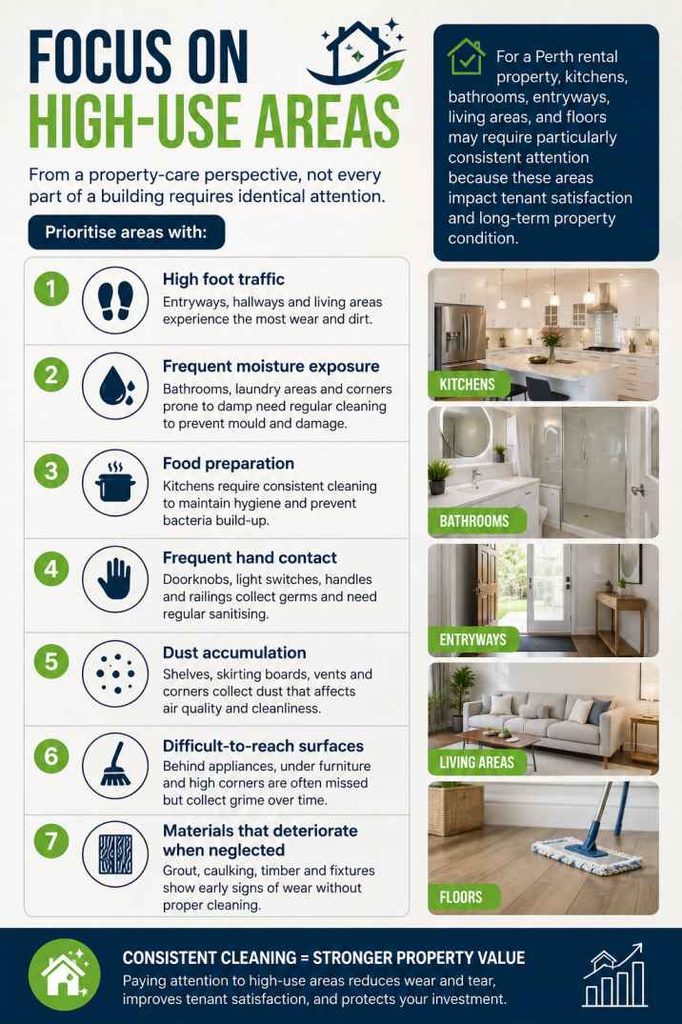
Focus on High-Use Areas
From a property-care perspective, not every part of a building requires identical attention.
Prioritise areas with:
- High foot traffic
- Frequent moisture exposure
- Food preparation
- Frequent hand contact
- Dust accumulation
- Difficult-to-reach surfaces
- Materials that visibly deteriorate when neglected
For a Perth rental property, kitchens, bathrooms, entryways, living areas, and floors may require particularly consistent attention because they experience substantial everyday use.
Preventative Cleaning Supports Property Maintenance
Preventative Cleaning works on a straightforward principle: deal with buildup before it becomes difficult to manage.
This approach complements broader Property Maintenance.
Imagine an owner conducting a routine property check. During cleaning, someone notices:
- A damp patch under a bathroom vanity
- Peeling sealant around a shower
- Water staining near a window
- Mould-like growth in a poorly ventilated corner
- A loose fixture
- Damage previously hidden by accumulated dirt or clutter
Cleaning does not necessarily solve these problems.
But it can make them visible.
That distinction is important.
A good cleaning routine can effectively provide another set of eyes on a property, helping owners notice changes that deserve further investigation.
Cleaning as an Early Warning System
Experienced property managers and maintenance professionals know that early identification often makes property problems easier to manage.
A cleaner working systematically through a property may notice that something has changed since the previous visit.
For example, a new stain beneath a sink may not be a cleaning issue at all. It could indicate a plumbing leak.
Likewise, recurring mould in a particular location could indicate excessive moisture or inadequate ventilation.
The appropriate response is not simply to clean harder.
The observation should prompt further investigation by the appropriate professional.
This is one reason experienced Cleaners in Perth can provide practical value when they work carefully and consistently. Familiarity with a property can make unusual changes easier to notice and report.
Long-Term Property Care Requires Consistency
Property maintenance is rarely about one major action.
It is usually the result of many smaller actions performed consistently.
Cleaning follows the same pattern.
A property that receives moderate, consistent attention is generally easier to maintain than one that is allowed to deteriorate for long periods and then receives a major clean.
A Practical Cleaning Cycle
A useful approach is to divide cleaning into different levels according to the property’s use and condition.
Daily or Frequent Cleaning
Focus on:
- Food preparation surfaces
- Spills
- Bathrooms
- High-touch points
- General floor maintenance
- Rubbish removal
Weekly Cleaning
Add:
- Thorough vacuuming
- Mopping
- Dusting
- Bathroom cleaning
- Kitchen cleaning
- Common surface cleaning
Periodic Detailed Cleaning
Focus on:
- Window tracks
- Skirting boards
- Cabinet details
- Hard-to-reach areas
- Areas behind furniture
- Built-up bathroom residue
- Appliance exteriors
- Less frequently addressed surfaces
The exact schedule depends on occupancy, household activity, pets, environmental conditions, property type, and usage.
There is no universal cleaning schedule that works for every property.
The important point is consistency.
Investment Protection for Rental Property Owners
For landlords, cleaning has another dimension: tenant turnover and property presentation.
A rental property must withstand repeated cycles of occupation.
Between tenants, owners and property managers may need to evaluate the condition of:
- Flooring
- Walls
- Kitchens
- Bathrooms
- Fixtures
- Windows
- Doors
- Appliances
- Common areas
A detailed clean can help establish a clearer baseline between tenancies.
For example, if a property is thoroughly cleaned and documented before a new tenant moves in, it becomes easier to identify changes later.
This does not replace professional property inspections or condition reports, but it complements them.
Cleaning Between Tenancies
A turnover clean should not be limited to the areas immediately visible during a quick walkthrough.
Pay attention to:
- Inside cupboards
- Drawer surfaces
- Kitchen appliances
- Bathroom fixtures
- Shower screens
- Window sills
- Window tracks
- Floors and edges
- Doors and handles
- Built-up residue
The objective is to return the property to a clean, usable condition and establish a consistent standard for the next occupancy.
Why Perth Properties Need a Practical Cleaning Strategy
Perth homes experience a combination of environmental and lifestyle factors that can affect cleaning requirements.
Dust, outdoor debris, seasonal weather changes, regular outdoor activity, and everyday household use can all contribute to dirt accumulation.
Homes with open windows, pets, children, gardens, or high levels of foot traffic may require more frequent attention in particular areas.
The correct cleaning schedule should therefore reflect how the property is actually used.
There is no universal “perfect” cleaning frequency.
A lightly occupied apartment and a busy family home should not necessarily follow the same schedule.
Likewise, a rental property between tenants requires a different approach from an owner-occupied home receiving routine maintenance.
Practical Strategies for Better Detailed Cleaning
Good cleaning is easier to maintain when there is a repeatable process rather than an improvised approach.
Create a Property-Specific Checklist
Instead of relying entirely on memory, create a checklist for the property.
Include both frequently cleaned areas and commonly forgotten areas.
Kitchen
Check:
- Benchtops
- Splashbacks
- Cabinet fronts
- Handles
- Appliance exteriors
- Sink and taps
- Floor edges
- Corners
Bathroom
Check:
- Shower screen
- Tiles
- Grout
- Taps
- Vanity
- Mirrors
- Toilet
- Floor edges
- Ventilation areas
Living Areas
Check:
- Floors
- Skirting boards
- Doors
- Handles
- Light switches
- Furniture edges
- Accessible high surfaces
Windows
Check:
- Glass
- Frames
- Sills
- Tracks where appropriate
A checklist makes cleaning more consistent and reduces the likelihood of repeatedly overlooking the same areas.
Prioritise Buildup Rather Than Just Visible Dirt
A detailed approach is not simply about cleaning whatever looks dirty.
Look for substances that accumulate gradually, including:
- Grease
- Soap residue
- Dust
- Mineral deposits
- Food residue
- Moisture-related buildup
Addressing these regularly can be easier than attempting to restore heavily neglected surfaces later.
Common Cleaning Mistakes That Can Affect Property Condition
Only Cleaning What Visitors See
If cleaning is performed only for appearance, hidden areas are easily neglected.
A property can look excellent from the doorway while window tracks, skirting boards, cabinet edges, and other areas remain heavily soiled.
Waiting Until the Property Looks Dirty
Visible dirt is not always a reliable indicator of buildup.
Some residues accumulate gradually without becoming immediately obvious.
Using the Same Cleaning Method on Every Surface
Different materials require different care.
Natural stone, timber, laminate, glass, stainless steel, painted surfaces, and specialty finishes can respond differently to cleaning products and techniques.
Using an overly aggressive product can cause more damage than the residue it was intended to remove.
Ignoring Moisture
Bathrooms, laundries, kitchens, and poorly ventilated areas deserve particular attention.
Persistent moisture should never simply be treated as a cleaning problem. If an area repeatedly develops mould or dampness, the underlying moisture source should be investigated.
Treating Cleaning and Maintenance as Separate
Cleaning can reveal maintenance issues.
Maintenance can also affect cleaning requirements.
For example, damaged grout or deteriorating sealant may make a bathroom increasingly difficult to keep clean.
Addressing the underlying maintenance issue can therefore make future cleaning easier.
Expert Tips for Property Owners
Tip 1: Photograph Problems When You Find Them
If cleaning reveals a stain, damaged sealant, cracked surface, or unusual moisture, take a photograph and record where it was found.
This creates a useful maintenance history and can make it easier to communicate concerns to a property manager, tradesperson, or contractor.
Tip 2: Track Recurring Problems
If the same area repeatedly becomes dirty, damp, or affected by mould-like growth, look beyond the cleaning itself.
Recurring problems can point toward ventilation, moisture, drainage, or building-maintenance concerns.
Tip 3: Match Cleaning Frequency to Property Use
Do not create a schedule based solely on a generic recommendation.
Consider:
- Occupancy
- Number of residents
- Pets
- Children
- Foot traffic
- Cooking frequency
- Property size
- Rental turnover
- Environmental exposure
Tip 4: Protect Delicate Finishes
Before using a strong cleaning product, determine whether the surface can tolerate it.
Natural stone, timber, specialty coatings, and some painted or finished surfaces may require specific cleaning methods.
When uncertain, follow the manufacturer’s care instructions or seek advice from someone familiar with the material.
Tip 5: Treat Detailed Cleaning as Preventative Care
Do not wait for a property to look neglected before arranging a more comprehensive clean.
Periodic detailed attention can help keep ordinary cleaning manageable and make accumulated dirt less likely to become a difficult restoration problem.
When Professional Cleaning Makes Sense
There are situations where professional assistance is particularly practical.
These can include:
- Large homes
- Rental properties
- Vacant properties
- Pre-sale preparation
- Post-renovation cleaning
- Tenant turnover
- Properties that have been neglected
- Homes requiring periodic detailed cleaning
The benefit is not simply speed.
Experienced cleaning teams can bring a systematic process, appropriate equipment, surface knowledge, and consistency that can be difficult to achieve when cleaning has to fit around a busy household or property-management schedule.
For owners using Cleaning Services in Perth, it is worth discussing the property’s specific needs rather than simply asking for “a clean.”
Explain the property type, areas of concern, cleaning frequency, occupancy, and any delicate surfaces.
A detailed scope produces a more useful cleaning result than a vague request.
How to Evaluate Cleaners in Perth
Price matters, but it should not be the only consideration when choosing a cleaning provider for an investment property or family home.
Ask practical questions such as:
- What areas are included?
- Is detailed cleaning available periodically?
- Are different surfaces treated according to their material?
- Can the cleaning plan be customised?
- How are concerns discovered during cleaning communicated?
- Are products and equipment appropriate for the surfaces?
- What happens if significant buildup is found?
Clear answers are generally more useful than broad claims about being the “best.”
The right provider should understand that property cleaning is about maintaining a real building with different materials, usage patterns, and maintenance needs.
For a business such as All Buzz Cleaning, the most useful approach is to understand what the property actually requires rather than applying exactly the same cleaning process to every home.
Final Thoughts
Good property ownership is rarely about waiting for problems to become obvious.
It is about recognising small signs of deterioration and addressing them early.
That is why Detailed Cleaning deserves to be considered part of a property’s long-term care strategy. While cleaning cannot prevent every form of wear or guarantee a higher selling price, consistent attention to surfaces, fixtures, wet areas, kitchens, floors, windows, and overlooked spaces can help preserve presentation and reduce avoidable buildup.
For homeowners and investors, the bigger picture is Asset Preservation, Preventative Cleaning, Property Maintenance, and Investment Protection.
A clean property is easier to live in, easier to present, easier to inspect, and often easier to maintain.
For property owners looking for dependable Cleaning Services in Perth, the most valuable approach is not necessarily cleaning more often. It is cleaning intelligently, consistently, and according to the property’s actual needs.
When cleaning becomes part of a broader property maintenance routine, the result is more than a better-looking home today. It is a practical investment in Long-Term Property Care.
Frequently Asked Questions
Does Detailed Cleaning actually increase property value?
Cleaning alone does not guarantee an increase in market value. Property value is influenced by numerous factors, including location, condition, improvements, demand, and broader market conditions.
However, consistent detailed cleaning can help preserve finishes, improve presentation, support tenant appeal, and reduce avoidable buildup. It is therefore more accurate to view cleaning as part of Property Value protection rather than a guaranteed value-adding renovation.
How often should a property receive Detailed Cleaning?
There is no universal schedule.
A busy family home may need periodic detailed cleaning more frequently than a lightly occupied property. Rental properties may benefit from detailed cleaning during tenancy changes, while owner-occupied homes can schedule deeper attention around seasonal or maintenance routines.
The key is to address buildup before it becomes difficult to remove.
Can cleaners identify property maintenance problems?
They can sometimes identify visible changes or unusual conditions while cleaning, such as water staining, damaged sealant, recurring mould-like growth, leaks, or surface deterioration.
However, cleaners are not necessarily building inspectors or tradespeople.
A cleaning professional can flag a concern, but the underlying problem should be assessed by an appropriately qualified professional where necessary.
Is Detailed Cleaning different from an end-of-lease clean?
There can be overlap, but they are not necessarily identical.
An end-of-lease clean is generally focused on preparing a rental property for handover according to the applicable tenancy expectations and agreed requirements.
Detailed cleaning is a broader concept focused on thoroughly addressing overlooked or accumulated dirt and maintaining the property’s condition.
The exact scope should always be agreed upon before work begins.
Can regular cleaning help protect a rental investment?
Yes, as part of a broader property maintenance strategy.
Regular cleaning can help keep surfaces and fixtures in better condition, improve presentation between tenancies, and make changes or maintenance concerns easier to notice.
It does not replace inspections, repairs, servicing, or preventive building maintenance. Instead, it complements those activities as part of long-term Investment Protection.