

September 22, 2026
The Importance of Professional Cleaning Documentation for Rental Handover
Moving out of a rental property involves more than packing boxes, returning keys, and leaving the premises tidy. One of the most overlooked parts of the process is cleaning documentation.
A property may look spotless, yet questions can still arise during the final inspection. Which areas were cleaned? When was the work completed? Were bathrooms, appliances, floors and windows addressed? Was the property returned in a condition consistent with the tenancy agreement?
This is where professional documentation can make the handover process clearer.
For tenants arranging End of Tenancy Cleaning Perth, cleaning records can provide useful evidence of what was completed before the property was handed back. They can also help cleaners work systematically rather than relying on memory or a quick visual check.
Whether you are a tenant preparing for a final inspection, a property manager coordinating a handover, or an owner preparing a property for its next occupant, understanding the role of cleaning documentation can prevent unnecessary confusion.
What Is Cleaning Documentation?
Cleaning documentation refers to written or digital records showing what cleaning work was carried out at a rental property.
It does not necessarily mean producing a complicated report. In practice, useful documentation may include:
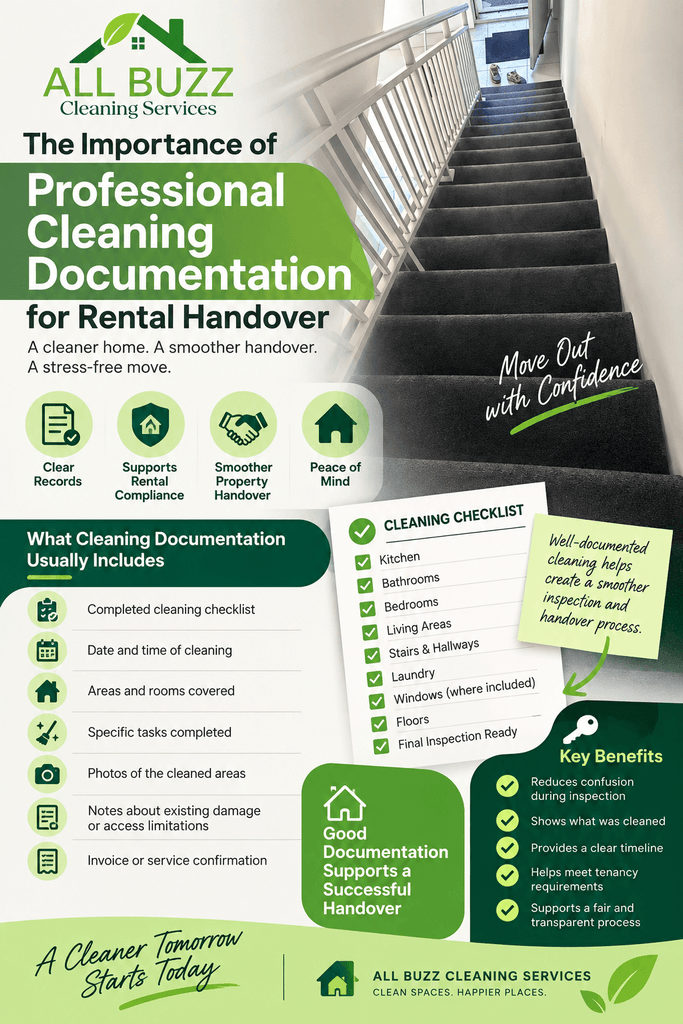
- A completed cleaning checklist
- Date and time of the cleaning service
- Areas and rooms covered
- Specific tasks completed
- Notes about existing damage or difficult areas
- Photographs taken after cleaning
- Additional services requested by the tenant
- Notes about areas that could not be cleaned because of access or pre-existing conditions
For a tenant, these records create a simple reference point between the cleaning service and the property handover.
Importantly, cleaning documentation is not a guarantee that a bond will be refunded. A property can have other issues involving damage, maintenance, rent or the terms of the tenancy agreement. Documentation simply helps establish a clearer record of the cleaning work performed.
Why Documentation Matters During a Rental Handover
The final handover can be stressful because several things happen at once. Keys are returned, inspections are conducted, condition reports may be reviewed and tenants are often focused on moving into their next property.
Cleaning records provide structure during this process.
Imagine a tenant has arranged an End of Lease Vacate Clean Perth service before moving out. The cleaner completes the kitchen, bathrooms, bedrooms, living areas and floors. A checklist records those tasks, while photographs document the finished condition.
If a question later arises about whether the oven or bathroom was cleaned, the tenant has something more useful than simply saying, “I had the property professionally cleaned.”
The documentation shows what was actually included.
Cleaning Records Create a Clear Timeline
A cleaning record can establish when the cleaning occurred.
This is particularly useful when cleaning takes place shortly before the final inspection. For example:
Monday: Tenant removes remaining belongings.
Tuesday morning: Professional cleaning takes place.
Tuesday afternoon: Final inspection occurs.
Wednesday: Keys and remaining handover requirements are completed.
A dated record helps connect these events.
It can also highlight a potential issue if an inspection occurs several days after cleaning and the property has subsequently been accessed by tradespeople, contractors or other occupants.
Documentation does not automatically resolve disputes, but it can provide useful context.
Cleaning Documentation and Rental Compliance
Tenants should always start with their tenancy agreement and condition report rather than assuming every property has identical cleaning requirements.
Some rental properties may require specific cleaning tasks, while others may have particular expectations regarding carpets, windows, ovens or outdoor areas.
This is why Rental Compliance should be considered alongside cleaning.
Professional cleaners can help interpret a cleaning checklist, but they should not replace the property manager’s instructions or the legal requirements applying to a tenancy.
A practical approach is to compare three things:
- The original property condition report.
- The tenancy agreement and any relevant cleaning requirements.
- The cleaning service checklist.
This comparison helps identify areas that require attention before the handover.
For example, if the original condition report describes the oven as clean and the tenancy agreement expects the property to be returned in a comparable condition, the oven should not be overlooked simply because the kitchen surfaces appear spotless.
What a Useful Service Checklist Should Include
A Service Checklist is one of the most practical forms of cleaning documentation.
A good checklist should be specific enough to show what was actually addressed. A vague statement such as “whole house cleaned” provides limited information.
A more useful checklist might separate tasks by room.
Kitchen
Typical items can include:
- Benchtops and splashbacks
- Cabinet fronts
- Interior and exterior of the oven
- Cooktop and rangehood
- Sink and tapware
- Floors
- Appliance exteriors
- Accessible areas around fixtures
The precise scope depends on the service booked and the property’s requirements.
Bathrooms
Documentation may identify:
- Shower screens
- Shower walls
- Bathtubs
- Toilets
- Basins
- Mirrors
- Vanity surfaces
- Tapware
- Floors
- Accessible grout areas
Bathrooms are often heavily scrutinised because soap residue, water marks, mould-like staining and built-up grime can be noticeable during inspection.
Bedrooms and Living Areas
The checklist may cover:
- Dusting accessible surfaces
- Skirting boards
- Doors and handles
- Light switches
- Floors
- Built-in wardrobes
- Accessible shelving
- Cobweb removal
- Internal windows where included
Laundry and Utility Areas
These spaces can easily be forgotten during a rushed move.
A checklist can include:
- Laundry tub
- Cabinet surfaces
- Appliance exteriors
- Floors
- Accessible walls and surfaces
- Cupboard interiors where required
The purpose is not to create paperwork for its own sake. The purpose is to reduce omissions.
Property Handover: Where Documentation Becomes Especially Useful
Property Handover is effectively a transition point between one stage of occupancy and the next.
At this point, several parties may be involved:
- Tenant
- Property manager
- Property owner
- Cleaning company
- Maintenance contractors
- Incoming tenant
Each party may have a different responsibility.
A cleaning record helps isolate the cleaning component of the handover.
For example, suppose a tenant’s final inspection identifies a damaged cupboard hinge. A cleaning checklist cannot prove who caused the damage, because cleaning documentation is not a damage report. However, photographs taken before or after cleaning may help establish the condition observed at a particular time.
This distinction matters.
Cleaning documentation records cleaning work. Condition reports record property condition. They can support one another, but they serve different purposes.
Inspection Documentation: What Should You Keep?
Inspection Documentation can be particularly valuable when combined with cleaning records.
Tenants should consider keeping copies of relevant documents rather than relying on the cleaner or property manager to retain everything indefinitely.
Useful records may include:
- Original condition report
- Cleaning booking confirmation
- Cleaning checklist
- Invoice or receipt
- Completion notes
- Relevant photographs
- Emails concerning cleaning requirements
- Final inspection communication
Keep the records together in one folder, preferably in digital form as well as any required paper copies.
This makes it much easier to locate information if a question arises weeks later.
Why Photographs Can Strengthen Cleaning Records
Photographs provide visual context that a checklist cannot.
A checklist might state:
Kitchen appliances cleaned.
A photograph can show the actual appearance of the kitchen after the work was completed.
However, photographs should be taken thoughtfully.
Useful photos should be:
- Clear and well-lit
- Taken after cleaning
- Wide enough to establish context
- Supported by close-ups where necessary
- Dated where possible
- Stored securely
Avoid taking hundreds of nearly identical photographs. A small, organised set of representative images is usually more useful than an enormous camera roll.
For example, a tenant might photograph the cleaned oven interior, bathroom, kitchen, living room, bedrooms and other areas that were specifically highlighted in the tenancy requirements.
A Real-World Example: When Documentation Prevents Confusion
Consider a tenant moving out of a two-bedroom apartment.
The tenant books Perth End of Lease Cleaning several days before the final handover. The cleaner completes a room-by-room checklist and records several areas requiring special attention.
The tenant also takes photographs after the cleaning.
During the inspection, the property manager notices dust inside one wardrobe.
Instead of having an unclear conversation about whether the entire property was cleaned, the tenant can refer to the service checklist and cleaning photographs. If the wardrobe interior was included and the photograph clearly shows its condition, there is a factual basis for discussing the issue.
The documentation may not automatically mean the tenant is considered to have met every requirement. The actual condition and tenancy terms still matter.
But the conversation becomes evidence-based rather than relying entirely on memory.
How to Build a Practical Cleaning Documentation Process
You do not need an elaborate administrative system.
A simple process can work well.
1. Review the Condition Report
Before booking a cleaner, compare the property’s current condition with the original condition report.
Pay particular attention to:
- Kitchen appliances
- Bathrooms
- Floors
- Windows
- Walls
- Carpets
- Outdoor areas
- Built-in storage
2. Confirm the Cleaning Scope
Ask exactly what the cleaning service includes.
Do not assume that terms such as “end of lease clean” automatically include every possible task.
Clarify whether services such as these are included:
- Oven cleaning
- Window cleaning
- Carpet cleaning
- Wall spot cleaning
- Balcony cleaning
- Garage cleaning
- Blind cleaning
- Interior cupboards
3. Use a Room-by-Room Checklist
Break the property into manageable sections.
This reduces the chance that small areas will be forgotten during a busy move.
4. Photograph the Finished Property
Take sensible photographs once the cleaning has been completed and belongings have been removed.
5. Keep the Documentation Together
Save the invoice, checklist, photographs and relevant tenancy communications in one folder.
This takes only a few minutes but can save considerable time later.
Common Mistakes Tenants Make
Even when tenants understand the importance of cleaning, several mistakes occur repeatedly.
Assuming Professional Cleaning Guarantees a Bond Refund
Professional cleaning is not the same thing as satisfying every tenancy obligation.
A cleaner can perform the agreed service properly, but other issues may affect the final outcome.
Relying Only on a Receipt
A receipt proves that a service was purchased. It usually does not explain exactly what work was performed.
A detailed checklist provides more useful information.
Ignoring the Original Condition Report
The property’s required standard may be easier to understand when the original condition is reviewed.
Tenants should not rely solely on generic cleaning advice found online.
Taking Photographs After Moving Back In
Photographs are most useful when they accurately represent the property at the relevant stage of handover.
Assuming Every Cleaning Company Uses the Same Process
Cleaning businesses have different scopes, checklists and documentation practices.
Ask what records are supplied before booking.
How Affordable End of Lease Cleaning Perth Can Still Be Thorough
The phrase affordable end of lease cleaning Perth should not be interpreted as simply finding the cheapest available quote.
A low upfront price may not represent good value if important tasks are excluded and need to be arranged separately.
When comparing cleaning services, consider:
- Scope of work
- Room-by-room checklist
- Additional charges
- Documentation provided
- Cleaning products and equipment
- Availability around inspection dates
- Experience with rental properties
- Clarity of the service agreement
An affordable service should have a clearly defined scope so you know what you are paying for.
This is particularly important when the final inspection is close. Last-minute additions can increase both cost and stress.
Professional Tips for Better Rental Handover Documentation
Keep Before-and-After Evidence Separate
If you take photographs before cleaning and after cleaning, label them clearly.
This prevents confusion when reviewing the records later.
Photograph Existing Damage
If you notice damage that was already present, document it separately from your cleaning photographs.
Do not rely on cleaning records to prove responsibility for property damage.
Request Specific Notes
If a cleaner cannot complete a task because an area is inaccessible or requires specialist treatment, ask for the limitation to be recorded.
For example, heavy staining that cannot be removed through standard cleaning should not simply be described as “cleaned” if the stain remains.
Complete Cleaning Before the Final Walk-Through
Where practical, schedule the cleaning close enough to the final inspection that the property’s condition is still representative of the cleaned state.
At the same time, allow enough time to address legitimate cleaning omissions.
Read the Handover Instructions Carefully
If a property manager provides specific instructions, keep them with the cleaning checklist.
This helps ensure the cleaner’s scope aligns with the actual requirements.
What Professional Cleaners Should Be Transparent About
A trustworthy cleaning service should clearly explain its scope.
Customers should be cautious of vague promises such as “guaranteed bond approval” or claims that professional cleaning automatically satisfies every rental requirement.
A more professional approach is transparent:
- State what is included.
- Explain what costs extra.
- Identify specialist services.
- Provide a checklist where applicable.
- Record relevant limitations.
- Provide an invoice or service confirmation.
- Avoid making legal guarantees about tenancy outcomes.
This transparency supports trust and helps tenants make informed decisions.
The Difference Between Cleaning Records and Legal Evidence
It is important not to overstate what cleaning documentation can achieve.
A cleaning checklist is useful evidence that certain work was performed. It is not necessarily a legal determination that the property met every tenancy requirement.
Similarly, photographs can show the condition of an area at a particular moment, but they cannot establish everything about how or why that condition occurred.
If a serious tenancy dispute develops, the appropriate process will depend on the circumstances and applicable Western Australian tenancy rules.
For routine handovers, however, good documentation can make communication considerably easier.
A Simple Rental Cleaning Documentation Checklist
Before completing your move-out, check whether you have:
- Original property condition report
- Current tenancy requirements
- Cleaning service confirmation
- Room-by-room service checklist
- Cleaning invoice or receipt
- Post-cleaning photographs
- Notes about pre-existing damage
- Notes about inaccessible or specialist areas
- Final inspection communication
- Key handover information
Keeping these records organised gives you a clear reference if questions arise.
Conclusion
A successful rental handover is easier when expectations, cleaning work and records are clearly organised.
Professional End of Tenancy Cleaning Perth can help address the physical cleaning requirements, but documentation adds another layer of clarity. A room-by-room checklist, dated service record, appropriate photographs and relevant tenancy documents create a useful record of what happened before the property was handed back.
The key is not producing paperwork for its own sake. Good documentation should answer practical questions: What was cleaned? When was it cleaned? What was included? Were any limitations recorded? What did the property look like afterwards?
For tenants looking for affordable end of lease cleaning Perth, the most useful approach is to compare the complete service rather than price alone. Clear scope, transparent communication and useful cleaning records can make the move-out process more organised and less stressful.
Ultimately, professional cleaning and sensible documentation work best together. One addresses the property’s presentation; the other creates a clear record of the work carried out.
Frequently Asked Questions
1. Why is cleaning documentation important for a rental handover?
Cleaning documentation provides a written record of the work completed, when it occurred and which areas were addressed. It can make discussions about cleaning more factual and organised, particularly when a final inspection occurs shortly after the service.
2. Does a professional cleaning checklist guarantee a bond refund?
No. A cleaning checklist only documents the cleaning service. Bond outcomes can depend on the property’s condition, tenancy obligations, damage, rent and other relevant matters. Tenants should review their agreement and condition report rather than treating a cleaning receipt as a guarantee.
3. What should I photograph after an end-of-tenancy clean?
Focus on representative areas such as the kitchen, bathrooms, floors, bedrooms, living areas, appliances and any locations specifically mentioned in the tenancy requirements. Images should be clear, well-lit and taken after belongings have been removed.
4. Is a cleaning invoice enough documentation?
An invoice confirms that a service was purchased, but it may not explain what was actually completed. A detailed service checklist, completion notes and appropriate photographs can provide considerably more useful information about the cleaning work.
5. How can tenants prepare for an end-of-tenancy inspection?
Start by reviewing the original condition report and tenancy requirements. Remove personal belongings, identify areas needing additional attention, confirm the cleaner’s scope, keep documentation and photograph the property’s condition after cleaning. Allow enough time between cleaning and the inspection to correct genuine omissions.