

October 7, 2026
How Professional Vacate Cleaning Supports a Faster Bond Assessment Process
Moving out of a rental property is rarely as simple as packing your belongings and handing over the keys. One of the biggest concerns for tenants is whether the property will meet the landlord or property manager’s expectations during the final inspection. A few missed areas can lead to cleaning requests, delays, or disputes over the bond.
This is where professional Vacate Cleaning Perth can make a practical difference. A properly planned end-of-tenancy clean helps prepare the property for its final Property Inspection, improves Cleaning Verification, and can make the overall Exit Process more straightforward.
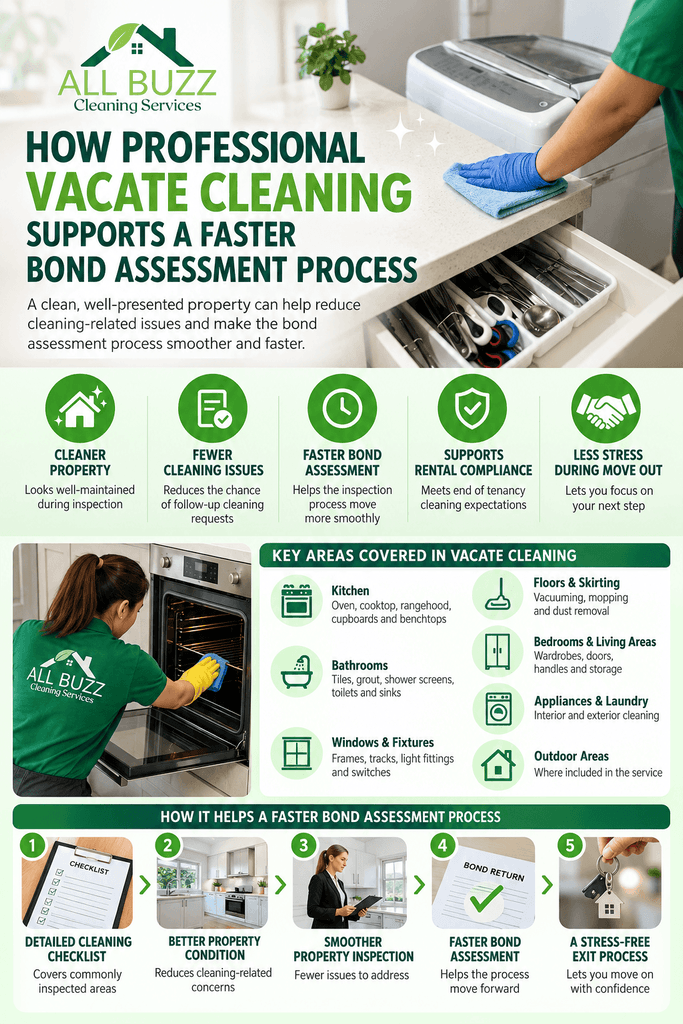
The goal is not simply to make a home look tidy. A professional vacate clean focuses on the areas that are commonly checked when a tenant leaves, including kitchens, bathrooms, floors, windows, fixtures, cupboards, and other frequently overlooked surfaces.
For tenants searching for cheap vacate cleaning Perth, however, price should not be the only consideration. A low-cost service that misses important areas may create more work later. The better approach is to compare the scope of cleaning, attention to detail, experience with rental properties, and understanding of Rental Compliance requirements.
Here is how professional cleaning can support a smoother and potentially faster bond assessment.
Why Vacate Cleaning Matters Before a Bond Assessment
A rental property is normally assessed against its condition at the beginning of the tenancy, allowing for reasonable wear and tear. Cleaning is therefore only one part of the final assessment, but it is an important one because visible dirt and neglected areas can make an otherwise well-maintained property appear poorly cared for.
Professional End of Lease Cleaning Perth services approach the property differently from an ordinary house clean.
Instead of concentrating only on visible surfaces, the cleaner works through areas that are commonly inspected at the end of a tenancy.
These can include:
- Inside kitchen cupboards and drawers
- Oven and cooktop
- Rangehood and filters
- Bathroom tiles and grout
- Shower screens
- Toilets and sinks
- Skirting boards
- Doors and handles
- Light fittings
- Floors and edges
- Window glass and frames where included
- Built-in wardrobes
- Laundry areas
- Dust and cobweb removal
- Accessible vents and fittings
The practical benefit is simple: the cleaner the property is when it is inspected, the fewer cleaning-related issues there are for the tenant to address.
It does not guarantee a bond refund because the final assessment can also consider damage, unpaid rent, gardening, maintenance, or other tenancy matters. But it can remove one common source of problems.
What Happens During a Bond Assessment?
Bond Assessment
A Bond Assessment is essentially an evaluation of the property’s condition at the end of a tenancy. The property manager or owner may compare the property’s current condition with the condition recorded at the beginning of the lease.
The process may involve checking:
- General cleanliness
- Damage beyond reasonable wear and tear
- Fixtures and fittings
- Floors and walls
- Kitchen and bathroom condition
- Appliances supplied with the property
- Outdoor areas where relevant
- Any outstanding maintenance or tenancy obligations
This is why simply vacuuming, mopping and wiping obvious surfaces may not be enough.
A tenant may believe the property is clean because it looks good at first glance. During a detailed inspection, however, accumulated grease inside an oven, dust on skirting boards or marks around cupboard handles can become noticeable.
A professional cleaning checklist helps reduce these avoidable oversights.
How Professional Cleaning Supports a Faster Property Inspection
Property Inspection
The final Property Inspection is easier when the property has already been prepared systematically.
Consider two scenarios.
Scenario one: A tenant cleans the property themselves over several evenings. They vacuum the floors, wipe benches and clean the bathroom. On inspection day, the property manager identifies grease inside the oven, dusty window tracks, dirty skirting boards and marks on several doors.
The tenant now has to return to the property or arrange another cleaner.
Scenario two: A professional cleaner works through a rental-specific checklist before the inspection. The cleaner pays particular attention to kitchens, bathrooms, fixtures, floors and commonly missed areas. The tenant also completes their own final walkthrough.
The second situation does not guarantee that the inspection will pass without comments, but it can significantly reduce cleaning-related follow-up.
That is one of the biggest practical advantages of professional cleaning: it moves the cleaning work from a reactive process to a planned process.
Cleaning Verification and the Importance of Evidence
Cleaning Verification
Cleaning Verification is not necessarily a formal legal step, but it is a useful practical concept for tenants preparing to leave.
It means checking whether the cleaning work has actually covered the areas that matter.
A useful final verification can include:
- Checking the oven from the inside
- Looking behind bathroom doors
- Inspecting shower glass under bright light
- Checking cupboard interiors
- Looking along skirting boards
- Checking corners for dust and cobwebs
- Inspecting floors from different angles
- Checking taps and stainless-steel surfaces for residue
- Looking at window tracks
- Checking appliances supplied with the rental
- Comparing the finished property with the original condition report
Photographs can also be useful for keeping a record of the property’s condition after cleaning.
For example, a tenant might photograph the cleaned oven, bathroom, kitchen, floors and other major areas before handing over the property. These images do not automatically prove that every tenancy obligation has been satisfied, but they provide a useful record of the property’s condition at the time the tenant left.
Why Rental Compliance Goes Beyond Making a Property Look Clean
Rental Compliance
Tenants sometimes assume that the standard for moving out is simply making the property look presentable.
In practice, the relevant requirements can be more specific. The tenancy agreement, original condition report and applicable Western Australian tenancy rules can all matter.
This is why tenants should not rely solely on a generic cleaning checklist.
A professional cleaner can help with the physical cleaning, but tenants should still review:
- Their tenancy agreement
- The original property condition report
- Any cleaning requirements agreed at the beginning of the tenancy
- Instructions from the property manager
- Requirements relating to carpets, windows or appliances
- Outdoor cleaning responsibilities
- Any maintenance issues that need to be reported separately
This distinction is important.
Cleaning and maintenance are not the same thing.
A cleaner can remove surface dirt from a wall, for example, but may not be responsible for repairing paint damage. Similarly, cleaning a carpet does not fix permanent staining or physical damage.
Understanding the difference helps prevent unrealistic expectations.
The Exit Process Becomes Easier With a Cleaning Plan
Exit Process
The final Exit Process can become stressful when cleaning is left until the last few hours.
A more practical approach is to work backwards from the handover date.
One to Two Weeks Before Moving Out
Start by reviewing the condition report and identifying areas that need additional attention.
Look for:
- Built-up kitchen grease
- Bathroom scale
- Carpet stains
- Marks on walls
- Dirty windows
- Neglected outdoor areas
- Damaged fixtures
- Broken fittings
This gives you enough time to arrange cleaning or repairs.
A Few Days Before Handover
Complete the bulk of the cleaning after most furniture and belongings have been removed.
This is important because empty rooms are easier to clean properly. Furniture can hide dust, marks and debris, particularly around skirting boards and corners.
The Day Before or Day of Handover
Carry out a final walkthrough.
Check:
- Floors
- Kitchen
- Bathrooms
- Cupboards
- Appliances
- Windows
- Doors
- Light fittings
- Laundry
- Outdoor areas
Do not rush this step.
A five-minute inspection with good lighting can reveal areas that were missed during the main clean.
What Professional Vacate Cleaning Typically Does Better
A professional Vacate Cleaning Services Perth provider generally approaches the job with a checklist and a rental-focused workflow.
That experience matters because cleaners who regularly work on end-of-tenancy properties know where dirt tends to accumulate.
For example, kitchen cleaning is rarely just about wiping the benchtop.
A thorough kitchen clean may involve:
- Degreasing the cooktop
- Cleaning the oven interior
- Wiping the rangehood
- Cleaning cupboard fronts
- Cleaning cupboard interiors
- Removing food residue from drawers
- Cleaning splashbacks
- Wiping handles and switches
- Mopping the floor
Bathrooms require a similar level of detail.
The cleaner may focus on:
- Soap residue
- Shower glass
- Grout
- Taps
- Basins
- Toilet surfaces
- Floor edges
- Mirrors
- Exhaust fan covers where accessible
- Cabinet interiors
These details can make a noticeable difference during a final inspection.
Is Cheap Vacate Cleaning Perth Always the Best Option?
Searching for cheap vacate cleaning Perth is understandable, especially when moving costs are already adding up.
However, comparing cleaning services purely by the lowest quoted price can backfire.
A cheaper quote may reflect:
- A smaller cleaning scope
- Fewer cleaners
- Less cleaning time
- Limited appliance cleaning
- Excluded windows
- Additional charges for heavily soiled areas
- No return-clean policy
- Basic rather than detailed cleaning
Before booking, ask exactly what the quoted price includes.
A useful comparison should consider:
Price + scope + experience + exclusions + quality assurance
For example, service that excludes oven cleaning, cupboards and several other areas may not represent better value than service that includes them.
The cheapest service is only genuinely cheaper if it delivers the cleaning standard you actually need.
Common Mistakes That Can Delay a Bond Assessment
Cleaning Only What Is Visible
Tenants often clean the rooms but overlook interiors.
Cupboards, drawers, ovens and wardrobes can accumulate dirt even when the rest of the property looks excellent.
Leaving Cleaning Until the Last Minute
If the property manager identifies cleaning issues after the keys have been returned, fixing them becomes much harder.
Cleaning before handover gives you an opportunity to correct missed areas.
Ignoring the Original Condition Report
The condition report provides important context.
If an area was already marked as worn or damaged at the beginning of the tenancy, it should not automatically be treated as a new cleaning issue.
Confusing Damage With Dirt
A dirty wall may be cleanable. A damaged wall may require repair.
These are different issues and should be treated accordingly.
Forgetting Appliances
Ovens, cooktops, rangehoods and other supplied appliances are commonly overlooked.
If they were clean when you moved in, they deserve particular attention when you move out.
Assuming Professional Cleaning Guarantees a Full Bond Refund
No legitimate cleaning company should guarantee a full bond refund.
A bond assessment can involve factors outside the cleaner’s control, including damage, rent arrears, maintenance and the property’s original condition.
Professional cleaning can reduce cleaning-related problems, but it cannot guarantee the outcome of the entire tenancy assessment.
Practical Tips for a Smoother Final Inspection
Here are several strategies that can make the process more manageable.
1. Use the Original Condition Report as Your Checklist
Don’t rely entirely on memory.
Compare the property with the original documentation and concentrate on areas that were clean when you moved in.
2. Clean After Removing Your Belongings
Empty rooms expose areas that furniture previously covered.
This makes it easier to identify dust, marks and debris.
3. Give the Kitchen Extra Attention
Kitchen grease can be surprisingly difficult to remove if it has accumulated over time.
Allow extra time for the oven, cooktop, rangehood, cupboards and splashback.
4. Inspect Bathrooms Under Strong Lighting
Soap residue and water marks can be difficult to see under dim lighting.
Bright lighting makes streaks and missed areas easier to identify.
5. Photograph the Finished Property
Take clear, date-relevant photographs after cleaning and before leaving.
Focus on major rooms, appliances and areas that could later become relevant to a discussion about the property’s condition.
6. Ask What Is Included Before Booking
If you use professional Vacate Cleaning Perth, ask for a written scope of work.
Clarify whether the service includes:
- Oven
- Rangehood
- Cupboards
- Windows
- Walls
- Carpets
- Garage
- Outdoor areas
- Additional heavy cleaning
This prevents misunderstandings.
Expert Advice for Tenants Planning Their Move
One practical lesson from end-of-tenancy cleaning is that preparation usually costs less stress than correction.
If a tenant waits until moving day to discover that the oven requires intensive degreasing or the bathroom grout needs detailed cleaning, there may not be enough time to resolve everything.
Instead, inspect the property several days before handover.
Walk through each room with the mindset of someone seeing the property for the first time.
Ask:
If I were inspecting this property today, what would immediately catch my attention?
That question often reveals more than a standard cleaning checklist.
Also remember that reasonable wear and tear is different from avoidable dirt. Normal ageing of a property does not mean a tenant should attempt to restore everything to brand-new condition.
The objective is to return the property in the condition required under the tenancy agreement and applicable rules—not to renovate it.
When Professional Cleaning Makes the Most Sense
Professional cleaning can be particularly useful when:
- You have limited time before handover
- The property is large
- You have been renting for several years
- The kitchen has significant grease buildup
- Bathrooms need detailed cleaning
- You are moving interstate
- You are managing multiple moving tasks
- You want a systematic final clean
- You are concerned about missing inspection areas
For a tenant with plenty of time and a manageable property, DIY cleaning can also be perfectly reasonable.
The important point is to judge the choice based on the property’s condition, available time and required cleaning scope rather than assuming professional cleaning is always necessary.
Final Takeaway
Professional Vacate Cleaning Perth can support a smoother bond assessment by helping tenants address the cleaning details that are easy to overlook during a busy move.
The biggest benefit is not simply a cleaner-looking home. It is the structured approach: cleaning according to the property’s condition, checking commonly inspected areas, documenting the finished condition and completing the work before the final Property Inspection.
If you are comparing End of Lease Cleaning Perth options, look beyond the headline price and assess the actual scope of work. The same applies when comparing Vacate Cleaning Services Perth providers.
And if your search begins with cheap vacate cleaning Perth, remember that value comes from getting the required work completed properly—not simply choosing the lowest quote.
A well-planned clean cannot guarantee a full bond refund, but it can remove many avoidable cleaning issues and make the final Exit Process considerably less stressful.
Frequently Asked Questions
1. Does professional vacate cleaning guarantee a faster bond assessment?
No. Professional cleaning can help prepare the property for inspection and reduce the chance of cleaning-related follow-up, but it cannot control how quickly a property manager completes the assessment.
The final process can also depend on property condition, outstanding repairs, rent, documentation and other tenancy matters. The practical advantage of professional cleaning is that one potential source of delay—unfinished or inadequate cleaning—is addressed before handover.
2. Should I choose cheap vacate cleaning Perth based only on price?
No. The lowest quote is not necessarily the best value.
Check what the price includes, particularly oven cleaning, cupboards, bathrooms, floors and other areas relevant to your property. Also ask whether heavily soiled areas, carpets, windows or additional work attract extra charges.
A slightly higher upfront price can be more economical if it provides the complete cleaning scope you actually need.
3. What should I clean before the final Property Inspection?
Start with the areas most likely to show visible dirt or accumulated residue. These include the kitchen, bathrooms, floors, cupboards, appliances, windows, skirting boards, doors and built-in storage.
Use your original condition report as a reference rather than relying only on memory. If a property was professionally cleaned when you moved in, try to achieve a comparable level of cleanliness where the tenancy agreement requires it.
4. Should I take photographs after vacate cleaning?
Taking photographs can be a sensible record-keeping step.
Photograph the main rooms and important areas such as the cleaned kitchen, oven, bathrooms, floors and other relevant fixtures after your belongings have been removed. Keep the images with your tenancy documents.
Photographs do not automatically establish that every tenancy obligation has been met, but they can provide useful evidence of the property’s condition when you handed it back.
5. Can a professional cleaner deal with damage identified during a bond assessment?
Not necessarily. Cleaning and repairs are separate responsibilities.
A cleaner may be able to remove marks, dirt or residue, but damaged walls, broken fixtures, damaged flooring or other physical problems may require a tradesperson or another appropriate solution.
Before arranging repairs, compare the issue with the original condition report and communicate with the property manager when necessary. This helps distinguish normal wear and tear from issues that may require attention.