
October 5, 2026
Why Professional Vacate Cleaning Is Essential for Pet-Friendly Rental Properties
Moving out of a rental property is already a busy process. You have furniture to pack, utilities to organise, belongings to sort, and a final inspection to prepare for. When pets have lived in the property, however, there is another layer to consider: cleaning the traces that everyday living with an animal can leave behind.
Pet hair can collect in corners, under furniture and along skirting boards. Odours may remain in carpets or soft furnishings even when a home looks clean. Small stains can become noticeable once the property is empty, while dust, dander and allergens can settle into areas that ordinary weekly cleaning rarely reaches.
This is why professional Vacate Cleaning Perth services can be particularly valuable for tenants who have lived with dogs, cats or other pets. A proper end-of-lease clean is not simply about making a property look tidy. It is about restoring the home’s presentation as thoroughly as reasonably possible before the final inspection.
For tenants looking for affordable end of lease cleaning Perth, the important question is not simply how much a cleaning service costs. It is whether the cleaning approach addresses the areas that are most likely to attract attention during a handover.
Why Pet-Friendly Rental Properties Need Extra Cleaning
Living with a pet creates cleaning requirements that are different from those of a pet-free household.
A dog may regularly enter the home after walking through grass, soil or wet areas. A cat may shed hair around sleeping areas, furniture and carpets. Both can leave behind dander, oils, odours and small particles that are difficult to notice during everyday life.
These issues can become much more visible when the property is empty.
For example, a tenant may vacuum the living room regularly and feel that the carpet is clean. But once the sofa and other furniture are removed, accumulated hair underneath the furniture may become obvious. Similarly, an odour that was barely noticeable while the property was occupied can become easier to detect when windows are open and the home is empty.
Professional cleaning is useful because it approaches the property as a handover space rather than as an ordinary lived-in home.
The focus should include:
- Floors and carpets
- Skirting boards
- Corners and edges
- Doors and frames
- Windows and tracks
- Kitchen surfaces
- Bathrooms
- Built-in cupboards
- Areas underneath furniture
- Pet-accessible surfaces
- Visible stains
- Odour sources
- High-touch areas
The goal is not to make unrealistic promises about removing every mark or smell. Instead, experienced cleaners identify what can reasonably be improved and treat the property systematically.
The Difference Between Regular Cleaning and End-of-Lease Cleaning
Regular household cleaning is designed to keep a home comfortable while someone is living there.
End-of-lease cleaning has a different purpose.
During regular cleaning, furniture remains in place, belongings occupy cupboards and surfaces, and cleaning tends to concentrate on frequently used areas. At the end of a tenancy, the property is usually much more exposed.
An empty room makes imperfections easier to see.
For example, a tenant might regularly clean the visible bathroom surfaces but rarely move into the corners behind fixtures. During a final inspection, accumulated dust or hair in these areas can stand out.
Likewise, vacuuming the centre of a carpet is not the same as carefully cleaning carpet edges and areas beneath furniture.
This is one reason House Vacate Cleaning Perth should be approached as a detailed property reset rather than a quick tidy-up.
A professional cleaner will generally work methodically through the property rather than cleaning only the areas that look dirty at first glance.
Pet-Friendly Rental Cleaning Requires More Than Vacuuming
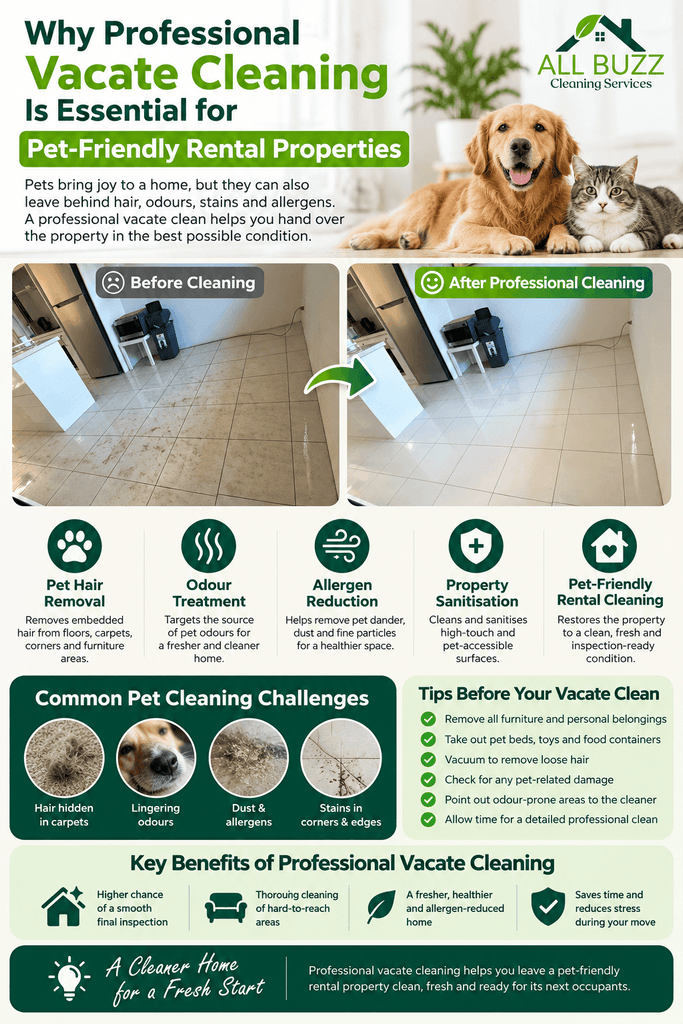
Pet Hair Removal
Pet hair is one of the most common problems after a pet has lived in a rental.
It can cling to carpet fibres, upholstery, curtains, rugs and fabric-covered furniture. Fine hair can also gather along skirting boards and underneath appliances or furniture.
A standard vacuum pass may not remove all of it.
Effective Pet Hair Removal often requires attention to edges, corners, fabric surfaces and places where airflow or foot traffic has pushed hair into compact areas.
A useful approach is to clean from high surfaces downwards and from less contaminated areas towards more heavily affected sections. This prevents freshly cleaned areas from being covered again as work continues.
Tenants can also make the final clean easier by:
- Removing all personal belongings first.
- Taking pet bedding and toys out of the property.
- Vacuuming after furniture has been removed.
- Checking corners and skirting boards manually.
- Looking beneath beds, sofas and cabinets.
- Cleaning hair from accessible vents and hard surfaces.
- Checking carpet edges before the final inspection.
If large amounts of hair have accumulated over a long tenancy, professional equipment and techniques can make a noticeable difference.
Odour Treatment Is About Finding the Source
Odour Treatment
Pet odour is often misunderstood.
Spraying an air freshener over a smell does not necessarily remove the underlying source. In fact, strong fragrances can temporarily mask an odour without solving the problem.
Odour Treatment should begin by identifying where the smell is coming from.
Potential sources can include:
- Carpet fibres
- Carpet underlay
- Pet bedding areas
- Hard flooring
- Grout lines
- Fabric surfaces
- Areas around feeding bowls
- Pet-accessible corners
- Accidental urine contamination
- Damp areas
The treatment required depends heavily on the source and material involved.
For example, a light surface odour may improve considerably after thorough cleaning and ventilation. A persistent smell caused by contamination that has penetrated carpet or another absorbent material may require more specialised treatment.
This is where realistic expectations matter.
A responsible cleaning professional should explain what cleaning can achieve rather than guaranteeing that every pet-related odour will disappear regardless of its cause.
Allergen Reduction Matters Even After the Pet Has Left
Allergen Reduction
A property can appear clean while still containing fine particles associated with pets.
Pet dander, dust and other airborne or settled particles can accumulate in carpets, soft furnishings, corners and ventilation areas.
Allergen Reduction is therefore another reason to take the final clean seriously.
This does not mean a cleaning company can make a property completely allergen-free. No ordinary cleaning service can make such a guarantee. The practical objective is to reduce removable dust, hair and debris from accessible surfaces.
Good cleaning practices may include:
- Thorough vacuuming
- Damp wiping of hard surfaces
- Cleaning skirting boards
- Removing visible hair and dust
- Cleaning accessible shelves
- Cleaning window tracks
- Wiping doors and frames
- Paying attention to corners
- Emptying and cleaning appropriate bins
For homes that have housed pets for several years, this detailed approach can produce a much cleaner handover environment.
Pet-Friendly Rentals Still Need Property Sanitisation
Property Sanitisation
Sanitisation is another area where tenants sometimes have unrealistic expectations.
Cleaning and sanitising are not identical. Cleaning physically removes dirt, debris and contaminants from surfaces. Sanitisation aims to reduce microorganisms on suitable surfaces using appropriate products and methods.
For a rental property, Property Sanitisation should be targeted rather than treated as a substitute for thorough cleaning.
Frequently touched areas such as handles, switches, bathroom surfaces and kitchen worktops deserve attention. Pet-accessible hard surfaces may also require appropriate cleaning based on the material.
The correct product matters too. A chemical that works well on one surface may damage another.
Professional cleaners should therefore consider the surface before choosing a cleaning method.
Why Empty Homes Reveal More Pet-Related Problems
One practical lesson experienced cleaners often notice is that a home can look considerably different once it has been emptied.
Furniture hides floors. Rugs conceal carpet. Beds hide dust. Storage boxes cover cupboards and corners.
After everything is removed, the property becomes easier to assess.
Consider a living room where a dog has spent most evenings near the sofa. During the tenancy, the area may look perfectly acceptable because the sofa covers part of the floor. Once the sofa is removed, hair may be visible around the carpet perimeter.
The same applies to bedrooms.
A cat that regularly sleeps underneath a bed can leave behind hair and dust that is rarely noticed during normal cleaning.
This is why the final clean should ideally take place after the majority of belongings and furniture have been removed.
Practical Steps Before Booking Vacate Cleaning
Tenants can make the cleaning process more efficient by preparing the property first.
1. Remove All Personal Belongings
Cleaners work more effectively when surfaces, cupboards and floors are accessible.
Remove:
- Furniture
- Clothing
- Boxes
- Pet toys
- Pet beds
- Food containers
- Personal decorations
- Rubbish
2. Remove Pet Items Early
Pet bedding can hold considerable amounts of hair and odour. Washing or removing these items before the final clean prevents them from reintroducing hair into freshly cleaned areas.
3. Check for Visible Pet Damage
Cleaning cannot repair physical damage.
Inspect for:
- Scratched doors
- Chewed skirting boards
- Damaged flyscreens
- Carpet damage
- Scratched flooring
- Damaged blinds
- Broken fixtures
Cleaning and repairs are separate issues, so identifying them early gives you time to deal with them appropriately.
4. Identify Persistent Odours
If you notice a particular smell, tell the cleaner where it seems strongest.
Useful information might include whether:
- The smell comes from a particular room.
- A pet regularly slept there.
- There was a previous accident.
- The area has experienced dampness.
- The odour becomes stronger in warm weather.
This information can help determine the most appropriate cleaning approach.
Common Mistakes Tenants Make With Pet Cleaning
Mistake 1: Cleaning Around Furniture
If furniture is still present, it is easy to miss hair and dust underneath it.
Where possible, remove furniture before the final clean.
Mistake 2: Using Fragrance Instead of Cleaning
A strongly scented product can make a room smell different without actually removing the source of an odour.
Clean first. Treat the source where appropriate. Use fragrance cautiously.
Mistake 3: Leaving Pet Hair Until the Last Minute
Large quantities of pet hair can take longer to remove than expected.
Start removing it before moving day instead of leaving the entire task until the final evening.
Mistake 4: Assuming a Quick Vacuum Is Enough
Pet hair can become embedded in carpet fibres and collect around edges.
A proper end-of-lease clean requires more attention than ordinary daily vacuuming.
Mistake 5: Ignoring Windows, Tracks and Skirting Boards
These areas can collect surprisingly large amounts of dust and hair.
They are easy to overlook because they are not normally part of a quick household clean.
Mistake 6: Making Unrealistic Cleaning Claims
Not every stain or odour can be removed through cleaning alone.
Age, material, contamination depth and previous treatment can all affect the result. Good cleaning advice should acknowledge these limitations.
How to Choose Affordable End of Lease Cleaning Perth Without Cutting Corners
Searching for affordable end of lease cleaning Perth does not necessarily mean choosing the cheapest quote available.
The more useful comparison is based on what the service actually includes.
Before booking, ask:
- Is pet hair removal included?
- Are skirting boards cleaned?
- Are kitchen cupboards included?
- Are bathroom details covered?
- Are window tracks included?
- Is carpet cleaning separate?
- Are pet odour treatments available?
- Does the cleaner inspect the property before starting?
- What happens if a particular stain cannot be removed?
- Are additional charges explained in advance?
A transparent quote is usually more useful than a low headline price that excludes important tasks.
It is also worth checking whether the cleaner understands the difference between routine house cleaning and end-of-tenancy cleaning.
The latter should be organised around the condition and presentation of the property at handover.
When Professional Vacate Cleaning Is Especially Useful
Not every rental property needs the same level of professional assistance.
Professional Vacate Cleaning Services Perth can be particularly useful when:
- Multiple pets have lived in the home.
- There is substantial shedding.
- The property has extensive carpeting.
- Pet odours remain after normal cleaning.
- The tenancy was long-term.
- There is limited time before the final inspection.
- The property is large.
- The tenant is moving interstate.
- Several cleaning tasks need to be completed at once.
- The tenant wants a systematic final clean.
For a tenant with one small, short-haired pet in a small apartment, DIY cleaning may be manageable.
For a large family home with two dogs, carpeted bedrooms and several years of occupancy, the workload can be considerably greater.
The right choice depends on the property’s actual condition.
A Practical Final Inspection Checklist
Before considering the property finished, walk through every room slowly.
Living Areas
- Vacuum carpets thoroughly.
- Check underneath furniture.
- Remove visible pet hair.
- Clean skirting boards.
- Wipe doors and frames.
- Check corners.
Bedrooms
- Check carpet edges.
- Remove hair from corners.
- Clean wardrobes and shelves where required.
- Check behind and underneath furniture.
- Look for lingering odours.
Kitchen
- Clean benchtops.
- Clean the cooktop.
- Wipe cupboard fronts and accessible interiors.
- Clean splashbacks.
- Remove food residue.
- Clean floors thoroughly.
Bathroom
- Clean shower surfaces.
- Clean toilets.
- Remove visible soap residue.
- Clean vanity surfaces.
- Pay attention to floor edges.
- Check ventilation areas where accessible.
Laundry
- Clean floors.
- Wipe accessible surfaces.
- Remove lint and hair.
- Check around appliances.
- Remove rubbish and personal items.
Final Property-Wide Check
Walk through the property once more after cleaning.
Look at it from an inspection perspective rather than as the person who has lived there.
Ask yourself:
If this were the first time I had seen this property, what would immediately stand out?
That simple change in perspective can reveal missed areas.
Expert Advice for Pet Owners Preparing to Move Out
One of the most effective approaches is to start the process earlier than you think you need to.
Do not wait until the morning of the final inspection to discover that a pet’s hair has accumulated underneath furniture or that an old odour is more noticeable than expected.
A practical timeline is:
Several days before moving:
Remove unnecessary belongings and begin reducing clutter.
After furniture is removed:
Inspect floors, carpet edges, skirting boards and corners.
Before the final clean:
Remove pet bedding, toys, food containers and other pet-related items.
During cleaning:
Focus on hair, dust, stains, odours and high-use areas.
After cleaning:
Allow appropriate ventilation and complete a final visual inspection.
This approach reduces last-minute pressure and gives you time to address issues that require additional attention.
Frequently Asked Questions
1. Is professional Vacate Cleaning Perth necessary if I have kept my rental clean?
Not necessarily, but pet ownership can make the final clean more demanding than normal household cleaning. Even tenants who vacuum regularly may find accumulated hair underneath furniture, along skirting boards and in carpet fibres once the property is empty.
Professional cleaning can be useful when you want a systematic final clean or when the property has areas that are difficult to manage with ordinary household equipment. The decision should ultimately depend on the property’s condition, size, flooring and amount of pet-related residue.
2. Can professional cleaning completely remove pet odours?
Not always. The result depends on the source, material and severity of the odour. Surface-level smells may respond well to thorough cleaning, while contamination that has penetrated carpet, underlay or other absorbent materials can be more difficult.
A trustworthy cleaner should assess the situation realistically rather than promising that every odour can be eliminated. If the source involves physical damage or deep contamination, cleaning alone may not be sufficient.
3. What is the best way to deal with pet hair before an end-of-lease clean?
Start by removing all pet belongings and furniture from the property. Vacuum floors carefully, including corners and edges, and pay particular attention to areas underneath beds and sofas.
If hair has become embedded in carpets or fabrics, ordinary vacuuming may not remove everything in one pass. Additional mechanical removal or specialised cleaning techniques may be necessary depending on the material.
4. Does Pet-Friendly Rental Cleaning mean the property needs to be disinfected everywhere?
No. Cleaning and disinfection are different processes, and not every surface requires intensive disinfection.
The sensible approach is to thoroughly clean the property first and use appropriate sanitising methods on suitable high-touch or relevant surfaces. Cleaning products should always be compatible with the material being treated.
The objective is a clean, hygienic handover rather than unnecessary chemical use throughout the property.
5. How can I make affordable end of lease cleaning Perth more effective?
Preparation is one of the best ways to make the cleaning process more efficient. Remove all personal belongings and pet items before the cleaner arrives, empty cupboards where required, identify persistent odours, and point out areas that may need special attention.
When comparing Vacate Cleaning Services Perth, look beyond the advertised price. Check exactly what is included, whether pet-related cleaning is covered, and whether additional treatments such as carpet or specialised odour treatment are charged separately.
Conclusion
Moving out of a pet-friendly rental property requires more than simply making the rooms look tidy. Pet hair, odours, dander and accumulated dust can remain in places that are easy to overlook during everyday cleaning.
A detailed approach to Vacate Cleaning Perth helps address these issues systematically, particularly after furniture and belongings have been removed.
The most important point is to match the cleaning strategy to the property’s actual condition. Focus on Pet Hair Removal, sensible Odour Treatment, Allergen Reduction, suitable Property Sanitisation and the less obvious areas that become visible during a final inspection.
For tenants considering affordable end of lease cleaning Perth, affordability should be judged alongside scope, transparency and the quality of the work—not simply by choosing the lowest advertised price.
A clean, carefully prepared property gives you a better chance of presenting the rental in its best possible condition and makes the final move-out process considerably less stressful.