

September 11, 2026
Why Professional Vacate Cleaners Follow Structured Cleaning Workflows
Moving out of a rental property can feel straightforward until you start looking at the property through a landlord’s or property manager’s eyes. Marks on skirting boards, dust behind appliances, greasy kitchen surfaces, soap residue in the bathroom, and overlooked window tracks can all become noticeable during a final inspection.
This is where Vacate Cleaners Perth take a different approach from ordinary household cleaning. Professional vacate cleaning is not simply about making a property look tidy. It is a detailed process designed around the condition of the property, common inspection points, the scope of the cleaning agreement, and the expectations set by the rental arrangement.
A structured workflow helps cleaners avoid the biggest problem with move-out cleaning: inconsistency. Without a clear sequence, it is surprisingly easy to clean the obvious areas while missing less visible surfaces that may still matter during an inspection.
For tenants searching for reliable Perth Vacate Cleaners, understanding how a professional workflow operates can also make it easier to judge whether a cleaning service is genuinely thorough.
This guide explains why structured workflows matter, how professionals organise a property-wide clean, what quality control looks like in practice, and how tenants can prepare for a smoother final inspection.
What Is a Professional Cleaning Workflow?
A Professional Cleaning Workflow is a planned sequence of cleaning tasks rather than a collection of unrelated chores.
Instead of moving randomly from one room to another, cleaners establish:
- What needs to be cleaned
- Which areas require the most attention
- What cleaning method is appropriate for each surface
- Which tasks should happen before others
- How the finished work will be checked
This matters because vacate cleaning often involves several interconnected tasks.
For example, cleaning a kitchen floor before wiping dusty cupboards can create unnecessary rework. Dust and debris may fall onto the freshly cleaned floor. Similarly, cleaning bathroom mirrors before completing dusty work nearby can leave them marked again.
An experienced cleaner therefore considers sequence as well as effort.
A good workflow reduces duplicated work, prevents missed areas and gives cleaners a repeatable standard to follow across different properties.
Why Vacate Cleaning Requires More Structure Than Regular Cleaning
Regular domestic cleaning usually focuses on maintaining an acceptable living environment. Vacate cleaning has a different objective.
The tenant is preparing to hand the property back, which means accumulated dirt and neglected areas often need attention at the same time.
A property may appear clean during everyday living while still requiring substantial work before handover.
Consider a typical rental:
- The kitchen benchtop looks clean, but the cabinet fronts have grease marks.
- The bathroom appears tidy, but grout contains built-up residue.
- The living room floor has been vacuumed, but skirting boards are dusty.
- Bedrooms look presentable, but wardrobes contain dust and hair.
- Windows appear clean from a distance, but tracks contain debris.
None of these issues necessarily stands out during normal day-to-day living. During an end-of-tenancy inspection, however, they can become much more obvious.
This is why professional Perth Vacate Cleaning Services generally use a systematic process rather than relying on visual impressions alone.
The Role of a Cleaning Workflow in Move-Out Cleaning
A professional workflow acts almost like a checklist for the entire property.
The cleaner does not have to rely entirely on memory. Instead, tasks are grouped by room, surface and priority.
A practical workflow might look like this:
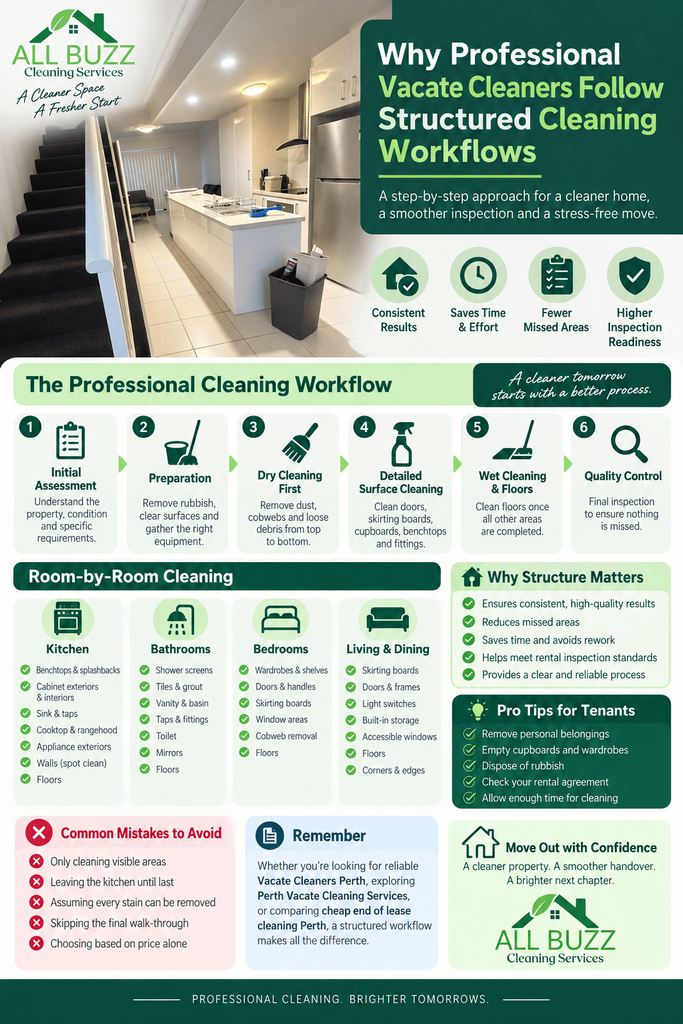
Initial assessment → preparation → dry cleaning → detailed surface cleaning → wet cleaning → floors → inspection → touch-ups
This sequence is useful because different stages support one another.
Initial Assessment
Before cleaning begins, professionals identify:
- Property size and layout
- Number of bedrooms and bathrooms
- Flooring types
- Kitchen condition
- Areas with heavy build-up
- Accessible and restricted areas
- Existing damage or wear
- Special cleaning requirements
This initial inspection also helps distinguish dirt from permanent damage.
For example, a stained carpet may have a mark that cannot reasonably be removed through standard cleaning. Documenting the condition before work begins helps avoid unrealistic expectations later.
Preparation
Preparation can include removing rubbish, clearing accessible surfaces and gathering suitable equipment.
The objective is simple: avoid repeatedly stopping the cleaning process to deal with preventable obstacles.
Dry Cleaning First
Dust, loose debris, cobwebs and hair are generally easier to remove before wet cleaning.
Professionals may work from higher surfaces downward so that falling dust is captured during later stages.
Detailed Surface Cleaning
Once loose dirt is removed, cleaners can concentrate on surfaces such as:
- Doors and door frames
- Skirting boards
- Cupboards
- Shelves
- Benchtops
- Switch plates
- Bathroom fittings
- Accessible window areas
Floors Near the End
Floors are usually one of the final major tasks because other cleaning activities can disturb them.
This is especially important in kitchens and bathrooms where water, cleaning solutions and loosened debris can otherwise create additional work.
Room-by-Room Cleaning Creates Consistency
One of the most effective ways professionals maintain standards is through Room-by-Room Cleaning.
Rather than cleaning whatever catches the eye, the cleaner completes defined areas systematically.
A room-based process may include:
Kitchen
Kitchen cleaning generally receives significant attention because grease and food residue can accumulate on multiple surfaces.
A structured approach may cover:
- Benchtops
- Splashbacks
- Cabinet fronts
- Cabinet interiors where included
- Sink and taps
- Cooktop
- Rangehood exterior
- Appliance exteriors
- Walls around cooking areas
- Floors
- Accessible corners and edges
The key is not simply wiping everything once. Different surfaces require different methods.
Grease, for instance, may need an appropriate degreasing product and sufficient dwell time rather than aggressive scrubbing.
Bathrooms
Bathrooms need attention to both appearance and hygiene.
A systematic process can include:
- Shower screens
- Tiles
- Grout
- Vanity
- Basin
- Taps
- Mirrors
- Toilet
- Floors
- Accessible ledges
- Soap residue and mineral build-up
A cleaner should also recognise that not every mark is removable. Permanent etching, damaged grout, corroded fittings or deteriorated sealant may require repair rather than cleaning.
Bedrooms
Bedrooms can look clean relatively quickly, but professional cleaners still work through a checklist.
Common tasks include:
- Wardrobes
- Shelving
- Doors
- Handles
- Skirting boards
- Accessible window areas
- Floors
- Corners
- Cobweb removal
Wardrobes are particularly easy to overlook when furniture has already been removed.
Living and Dining Areas
These areas often involve a mixture of surfaces.
Professionals may check:
- Skirting boards
- Doors and frames
- Light switches
- Accessible windows
- Built-in storage
- Shelves
- Floors
- Corners and edges
The goal is to create a consistent finish rather than simply making the room appear tidy.
Quality Control: The Step That Separates Thorough Cleaning From Fast Cleaning
Cleaning is only half of the job. Quality Control determines whether the work has actually met the intended standard.
A cleaner who finishes the last room and immediately leaves may miss small problems that become obvious under inspection lighting.
A quality-control stage gives the professional an opportunity to reassess the property as a whole.
What Does Quality Control Involve?
A final inspection can involve checking:
- High-visibility surfaces
- Kitchen grease and residue
- Bathroom water marks
- Mirrors and glass
- Floor edges
- Skirting boards
- Doors and handles
- Cupboards
- Visible dust
- Cobwebs
- Areas around appliances
The cleaner may also walk through the property in the same direction as a property inspection.
This is a useful practical technique because it changes the perspective from “What have I cleaned?” to “What could an inspector notice?”
That distinction is important.
How a Professional Checklist Prevents Missed Areas
A Professional Checklist is not merely administrative paperwork. Used correctly, it is a quality-control tool.
Humans naturally prioritise visually obvious tasks. A checklist counteracts that tendency.
For example, a cleaner may remember to clean the kitchen benchtop but overlook:
- The underside of the rangehood
- Cabinet edges
- Kickboards
- Behind handles
- Window tracks
- The area beside appliances
A checklist turns these potential omissions into deliberate inspection points.
It also helps maintain standards when several cleaners are involved.
If one cleaner handles the kitchen and another handles the bathrooms, both can work from defined expectations rather than interpreting “clean” differently.
Service Consistency Matters Across Different Properties
Service Consistency is particularly important for professional cleaning companies.
Every rental property is different. One may be a compact apartment with tiled floors, while another may be a large family home with multiple bathrooms and extensive carpet.
The workflow should therefore be structured enough to provide consistency without becoming rigid.
A useful system separates:
Standard tasks
from
Property-specific requirements
For example, checking doors and skirting boards can be part of the standard process. A heavily soiled oven, however, may require additional time and specialised treatment.
This distinction helps cleaners estimate work more realistically.
It also makes communication clearer for customers because the cleaner can explain what is included and where additional work may be required.
Why “Fast” Does Not Always Mean “Efficient”
There is a common misconception that the best vacate cleaner is simply the person who finishes fastest.
In professional cleaning, speed without a system can create more problems than it solves.
Suppose a cleaner spends less time on the property but misses several inspection points. The tenant may then have to arrange additional cleaning or return to address missed areas.
A structured workflow focuses on efficient completion, not simply rapid completion.
Efficiency means:
- Less repeated work
- Better task sequencing
- Appropriate equipment
- Clear priorities
- Fewer missed areas
- A defined final inspection
This is one reason experienced Vacate Cleaners Perth often appear methodical rather than hurried.
Where Cheap End of Lease Cleaning Perth Can Become a False Economy
Price is naturally important when moving house. Tenants often search for cheap end of lease cleaning Perth because moving involves many expenses at once.
However, the lowest advertised price does not necessarily represent the lowest overall cost.
A very low quote may reflect:
- A smaller cleaning scope
- Fewer included areas
- Limited time allocated to the property
- Additional charges for certain tasks
- Different standards of cleaning
- No detailed quality-control process
That does not mean an inexpensive service is automatically poor. A lower-cost provider may have an efficient operation and offer genuine value.
The important point is to compare scope and process, not price alone.
Before booking, ask:
- What rooms are included?
- Are cupboards included?
- Are internal windows included?
- Is oven cleaning included?
- Are walls spot-cleaned?
- What happens if additional cleaning is required?
- Is there a final inspection?
- How are exclusions communicated?
A transparent quote is much more useful than a low headline price with unclear inclusions.
Practical Strategies for Tenants Preparing for Vacate Cleaning
Professional cleaners can do much more effective work when the property is prepared properly.
1. Remove Personal Belongings First
Cleaning around boxes and furniture makes it harder to reach surfaces.
If possible, complete the move before the final clean.
2. Empty Cupboards and Wardrobes
An empty storage space allows the cleaner to access shelves, corners and the floor.
3. Dispose of Rubbish
Do not leave unwanted belongings throughout the property unless rubbish removal has been specifically arranged.
4. Check Your Rental Agreement
Different properties and agreements can have different requirements.
Look for instructions relating to:
- Carpets
- Gardens
- Windows
- Appliances
- Professional cleaning
- Keys and access
- Specific fixtures
5. Allow Enough Time
Do not schedule cleaning immediately before an unavoidable handover deadline if you can avoid it.
A little buffer gives you time to deal with unexpected issues.
Common Mistakes Tenants Make With Vacate Cleaning
Mistake 1: Cleaning Only What Is Visible
A property can look clean while still having substantial dust accumulation in cupboards, corners and tracks.
Mistake 2: Leaving the Kitchen Until the Last Minute
Kitchen grease often requires more effort than ordinary dust removal.
Mistake 3: Assuming Every Stain Can Be Removed
Some marks are caused by permanent surface damage, ageing, rust, discolouration or material deterioration.
Cleaning cannot always reverse those conditions.
Mistake 4: Ignoring the Final Walk-Through
A second inspection often catches small issues missed during active cleaning.
Mistake 5: Choosing Based Entirely on Price
Cost matters, but the cheapest option can become expensive if important tasks are excluded or need to be repeated.
Expert Tips for a More Reliable Vacate Cleaning Result
Experienced cleaners tend to develop small habits that make a significant difference.
Work From High to Low
Dust from higher surfaces can fall onto lower areas. Completing upper surfaces first reduces rework.
Work From Dry to Wet
Remove loose dust and debris before introducing moisture. This generally produces a cleaner result and prevents muddy residue.
Give Cleaning Products Time to Work
Some products need dwell time to break down grease or soap residue. Immediately scrubbing harder is not always the most effective approach.
Use the Correct Tool for the Surface
Glass, stainless steel, painted walls, natural stone and laminate should not automatically be treated in the same way.
Incorrect products can damage surfaces.
Photograph Existing Damage When Appropriate
Where there is visible pre-existing damage, documenting it before cleaning can help establish that the mark was not created during the cleaning process.
Perform a Final Inspection in Good Lighting
Lighting can reveal streaks, dust and marks that are easy to miss in dim conditions.
What Makes a Vacate Cleaning Workflow Professional?
A professional workflow is not defined by having a complicated checklist.
It is defined by whether the system produces repeatable, measurable and sensible results.
A strong workflow generally has five characteristics:
- Clear scope – everyone understands what is being cleaned.
- Logical sequencing – tasks are completed in an efficient order.
- Room-by-room accountability – individual areas are not forgotten.
- Surface awareness – cleaning methods are appropriate for the materials.
- Quality control – completed work is checked before the job is considered finished.
This approach benefits both the cleaner and the tenant.
The cleaner has a reliable process to follow. The tenant gets greater clarity about what has been done and what may still require attention.
Final Thoughts: Why Structure Matters in Vacate Cleaning
A successful move-out clean is rarely the result of simply working harder. It comes from knowing what to clean, how to clean it, when to clean it and how to check the result.
That is why structured workflows are so important for Perth Vacate Cleaners.
From the initial property assessment to the final quality-control walk-through, a systematic process reduces missed areas and unnecessary repetition. Room-by-room cleaning keeps the work organised, while a professional checklist provides a practical safeguard against forgotten details.
For tenants comparing Perth Vacate Cleaning Services, it is worth asking about the process behind the price. Whether you are considering a full-service provider or researching cheap end of lease cleaning Perth, look for clear inclusions, realistic expectations and a defined quality-control process rather than relying on price alone.
The most useful question is not simply, “How much does the clean cost?”
It is:
“What process do you follow to make sure the property is actually ready for handover?”
That answer can tell you considerably more about the quality of a cleaning service than an advertised price.
Frequently Asked Questions About Professional Vacate Cleaning
1. Why do professional vacate cleaners use a structured cleaning workflow?
A structured workflow helps cleaners work systematically instead of relying on memory or visual appearance alone. During a vacate clean, it is easy to overlook areas such as skirting boards, cupboard interiors, door frames, window tracks and corners. A defined workflow ensures each room and surface is addressed in a logical order and allows the cleaner to complete a final quality-control inspection before considering the job finished.
2. Does a professional vacate cleaning workflow guarantee a successful rental inspection?
No cleaning company can honestly guarantee a successful inspection because the final decision may depend on the property’s condition, existing damage, the rental agreement and the property manager or landlord’s expectations. However, a structured cleaning process can reduce the likelihood of cleaning-related issues being overlooked. Professional cleaners focus on commonly inspected areas and use a checklist to identify missed dirt, residue, dust and visible marks before handover.
3. What should I check before hiring Perth Vacate Cleaners?
Look beyond the advertised price. Ask exactly what is included in the service, whether kitchens and bathrooms receive detailed cleaning, whether cupboards and wardrobes are covered, and whether the company performs a final quality check. It is also useful to clarify exclusions and additional charges before booking. A transparent scope of work makes it easier to compare Perth Vacate Cleaners fairly and avoid unexpected costs.
4. Is cheap end of lease cleaning Perth always a good option?
Not necessarily. A lower price can represent good value when the cleaner has an efficient workflow and clearly defined inclusions. However, an unusually low quote may also reflect a limited cleaning scope or additional charges for tasks that other providers include. When comparing cheap end of lease cleaning Perth options, consider the total scope, cleaning process, experience and quality-control procedures rather than choosing solely on the initial price.
5. What can tenants do to help make vacate cleaning more effective? The biggest advantage tenants can provide is an empty and accessible property. Remove furniture and personal belongings before cleaners arrive, empty wardrobes and cupboards, dispose of unwanted rubbish and make sure cleaners can access the areas included in the service. It is also helpful to review the rental agreement beforehand so you understand any specific cleaning or handover requirements. This allows the Perth Vacate Cleaning Services team to concentrate on detailed cleaning rather than spending valuable time preparing the property.