

September 9, 2026
Why End of Lease Cleaning Standards Vary Between Perth Rental Properties
Moving out of a rental property in Perth can feel straightforward until you start comparing the cleaning expectations attached to different properties. One tenant may be asked to focus heavily on the oven, while another may receive detailed instructions about window tracks, outdoor areas, carpets, or wall marks.
This variation is not necessarily inconsistent. End of Lease Cleaning Perth requirements can differ because every rental property has its own condition, lease terms, fixtures, level of use, and expectations established by the property manager or owner.
Understanding those differences before you start cleaning can save time, prevent unnecessary disputes, and help you return the property in a condition that is appropriate for its circumstances.
For example, a recently renovated apartment with stainless-steel appliances may require very different attention from an older suburban house with established gardens, tiled outdoor areas and several years of normal wear. The cleaning process should reflect the actual property rather than relying on a generic checklist found online.
This guide explains why end-of-lease cleaning standards vary across Perth rentals, what tenants should look for in their lease and property condition reports, and how to approach cleaning realistically without paying for unnecessary work.
Why Do End of Lease Cleaning Standards Differ?
There is no single cleaning checklist that perfectly describes every Perth rental property.
The appropriate standard is influenced by several factors, including:
- The property’s original condition
- The condition documented when the tenancy began
- The length of the tenancy
- The type and age of fixtures
- The terms of the lease
- Normal wear and tear
- Property manager or owner’s reasonable expectations
- The property’s size and layout
- Whether outdoor areas are part of the tenancy
- Carpets, blinds, windows and appliances included with the property
A tenant who has lived in a property for several years should not necessarily be expected to reverse every sign of ordinary aging. At the same time, avoidable dirt, grease, stains or damage generally require attention.
This distinction is particularly important when arranging End of Tenancy Cleaning Perth services because a standard package may not automatically cover every feature of a particular property.
The goal should be to return the property appropriately clean while considering its documented condition and tenancy obligations.
End of Lease Standards: What Actually Determines the Cleaning Level?
When people search for End of Lease Standards, they often expect to find one universal checklist. In practice, the useful starting point is the individual tenancy documentation.
Start With the Property Condition Report
The entry condition report is one of the most valuable references available to a departing tenant.
It can help answer questions such as:
- Were the oven and cooktop clean when you moved in?
- Were the windows professionally cleaned?
- Were carpets already showing signs of wear?
- Were walls freshly painted?
- Were outdoor areas maintained?
- Were blinds dusty or marked at the beginning?
- Were appliances new, old or visibly used?
Your cleaning efforts should be considered alongside the property’s recorded starting condition.
Review the Lease Agreement
The lease may contain specific cleaning responsibilities. These could relate to particular fixtures, gardens, carpets, appliances or other areas.
This is where Lease Agreement Cleaning becomes important.
Instead of assuming that an online checklist applies to your property, read the clauses relevant to cleaning and maintenance. If the agreement contains an unusual requirement, clarify it with the property manager before spending money on additional services.
Consider the Property’s Actual Features
A two-bedroom apartment does not have the same cleaning requirements as a four-bedroom house.
Likewise, a townhouse with a courtyard may have different end-of-tenancy responsibilities from a high-rise apartment where the tenant has no private outdoor area.
Property Type Cleaning: Why Property Design Changes the Job
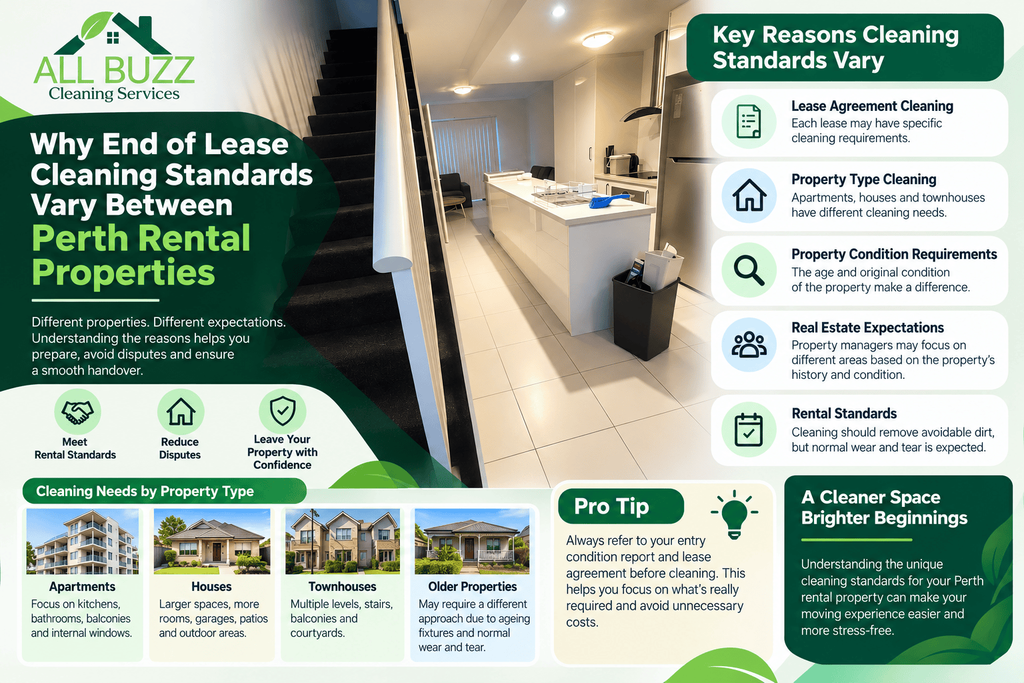
One of the biggest reasons cleaning standards vary is Property Type Cleaning.
Different properties naturally accumulate different types of dirt and require different cleaning techniques.
Apartments
Apartments often require attention to:
- Kitchens and compact appliances
- Bathrooms
- Balconies
- Sliding-door tracks
- Internal windows
- Built-in wardrobes
- Air-conditioning vents
- Hard floors
High-rise apartments can also have building-specific access requirements. For example, some windows may not be designed for tenant-accessible external cleaning.
Houses
Detached houses generally involve more cleaning zones.
Depending on the tenancy, these may include:
- Multiple bathrooms
- Larger kitchens
- Separate laundry areas
- Garages
- Patios
- Outdoor entertaining spaces
- Additional windows
- Larger floor areas
- Storage spaces
A house can therefore require substantially more preparation than a similarly priced apartment.
Townhouses
Townhouses sit somewhere between apartments and detached homes. They may include stairs, balconies, garages, courtyards and multiple living levels.
Stairs deserve particular attention because dust and hair can accumulate along edges and under furniture.
Older Rental Properties
Older homes require a slightly different mindset.
Paint may be aged. Silicone may have discolouration. Grout may have permanent staining. Fixtures may show years of ordinary use.
Professional cleaning can remove accumulated dirt, but it cannot always restore an aging fixture to a brand-new condition.
That is an important distinction when evaluating Property Condition Requirements.
Rental Standards and the Difference Between Cleaning and Wear
A common source of confusion is the difference between something being dirty and something simply being old or worn.
Imagine a tenant moves into a property with a carpet that already has flattened sections and mild discoloration.
After several years, the carpet may naturally look more worn. Deep cleaning may improve its appearance, but it cannot reverse fibre deterioration caused by age and ordinary use.
The same principle can apply to:
- Faded paint
- Worn carpet
- Minor fixture aging
- Weathered outdoor surfaces
- Established grout discoloration
- Naturally aged sealants
This is why Rental Standards should be considered in context rather than treated as a demand for everything to look newly installed.
Cleaning Problems vs Condition Problems
A useful practical test is:
Can the issue reasonably be improved through ordinary cleaning?
If yes, cleaning is probably appropriate.
If the issue results primarily from age, deterioration or ordinary use, cleaning may have limited impact.
For example:
Likely cleaning issue: Grease accumulated around an oven rangehood.
Likely wear issue: A decade-old rangehood with permanent surface discoloration despite reasonable cleaning.
Understanding this difference can prevent tenants from wasting hours trying to make aged materials look new.
Real Estate Expectations: Why Property Managers Inspect Differently
Another reason standards appear to vary is that property managers may focus on different areas depending on the property’s history and condition.
A property manager inspecting a recently renovated home may pay close attention to pristine surfaces and newer fixtures.
An older investment property may be assessed differently because some aging is already documented.
Real estate inspections can also be influenced by the property’s entry condition report, previous maintenance records and specific tenancy obligations.
What Property Managers Commonly Notice
From a practical cleaning perspective, inspection attention often falls on areas tenants overlook during everyday living:
- Oven interiors
- Rangehood filters
- Shower glass
- Bathroom exhaust fans
- Skirting boards
- Window tracks
- Cupboard interiors
- Behind appliances
- Laundry areas
- Built-in wardrobes
- Floor edges
- Light fittings
- Ceiling fans
These areas may not look particularly dirty during normal occupancy, but accumulated dust and grease can become obvious once the property is empty.
Property Condition Requirements: Why Empty Rooms Reveal More
Furniture hides a surprising amount of dirt.
A couch can conceal floor edges. A bed can hide dust beneath it. Kitchen appliances can obscure grime around walls and cabinets.
Once furniture is removed, the property manager can see areas that were previously inaccessible.
This is why a final clean should ideally happen after the majority of belongings have been removed.
Areas Worth Checking After Moving Furniture
Look at:
- Behind wardrobes
- Under beds
- Along skirting boards
- Behind sofas
- Inside cupboards
- Around appliance edges
- Under removable furniture
- Inside storage areas
The final inspection is effectively performed on the property itself, not on the version of the property that existed while furniture was covering it.
Why a Generic Cleaning Checklist Can Be Misleading
Online checklists can be useful, but they should be treated as guides rather than universal rules.
A generic checklist might tell you to clean:
- Every window
- All external areas
- Every blind
- All walls
- Every appliance
- Carpets throughout
But whether each task is necessary depends on the actual tenancy.
For instance, external window cleaning may not be reasonably accessible from inside an apartment. A tenant should not automatically assume that an online list overrides the property’s circumstances or their lease.
Likewise, a house with no carpet does not need carpet steam cleaning simply because a checklist includes it.
The smarter approach is to create a property-specific checklist.
End of Lease Cleaning Perth: How to Build a Property-Specific Checklist
Before cleaning, walk through every room with your entry condition report and lease nearby.
Create three categories.
Category One: Clearly Required
These are areas explicitly identified in your tenancy responsibilities or areas that are visibly dirty due to occupancy.
Examples include:
- Greasy kitchen surfaces
- Dirty bathrooms
- Food residue
- Dust accumulation
- Dirty floors
- Interior cupboards
- Appliance surfaces
Category Two: Condition-Dependent
These require comparison with the property’s starting condition.
Examples include:
- Carpets
- Walls
- Blinds
- Grout
- Paintwork
- Window coverings
Ask whether the current condition represents avoidable dirt or normal aging.
Category Three: Clarify Before Paying
Some tasks may require confirmation.
Examples might include:
- Professional carpet cleaning
- External windows
- Garden services
- Pest treatments
- Specialised stain removal
- High-access areas
If the requirement is unclear, asking the property manager before the final inspection may be more efficient than guessing.
Is Cheap End of Lease Cleaning Perth Always the Best Option?
Searches for cheap end of lease cleaning Perth are understandable when moving costs are already adding up.
However, price should not be the only consideration.
A very low-cost cleaning service may appear attractive but become expensive if important areas are excluded or require additional work later.
Instead, compare what is actually included.
Check the Cleaning Scope
Ask whether the quoted service includes the areas relevant to your property, such as:
- Oven
- Rangehood
- Bathrooms
- Cupboards
- Windows
- Floors
- Blinds
- Balcony
- Garage
- Laundry
- Interior doors
Avoid Paying for Work You Don’t Need
The opposite problem is also possible.
A tenant may purchase an extensive package containing services that are irrelevant to the property.
For example, paying for a large outdoor cleaning package makes little sense if the tenancy is a compact apartment with no private outdoor area.
A good cleaning plan should match the property rather than simply selecting the largest package.
End of Lease Cleaners Perth: Questions to Ask Before Booking
If you decide to use End of Lease Cleaners Perth, provide accurate information about the property before receiving a quote.
Useful details include:
- Property type
- Number of bedrooms and bathrooms
- Approximate size
- Number of floors
- Flooring types
- Carpeted areas
- Balcony or courtyard
- Garage
- Oven condition
- Window accessibility
- Any significant stains
- Special cleaning requirements
Photographs can also help a cleaner understand the property’s condition before arriving.
Ask About Re-Cleaning Policies
Rather than assuming every provider offers the same arrangement, ask what happens if the property manager identifies a cleaning-related issue after the service.
A transparent provider should be able to explain:
- What is covered
- What is excluded
- Whether return visits are available
- Whether additional charges apply
- What condition limitations exist
This is much more useful than choosing a service solely because it advertises the lowest price.
Common End-of-Lease Cleaning Mistakes
Mistake One: Cleaning Only What Is Visible
Tenants often concentrate on benches, floors and obvious bathroom surfaces.
Inspectors may notice the less obvious areas.
Better approach: Clean systematically from room to room and include hidden or rarely cleaned areas.
Mistake Two: Ignoring the Oven
The oven may look acceptable from outside while being heavily soiled internally.
Check:
- Oven cavity
- Door glass
- Racks
- Trays
- Cooktop
- Surrounding surfaces
- Rangehood
Mistake Three: Assuming Age Equals Dirt
A permanently discoloured surface is not necessarily dirty.
Don’t damage fixtures by using increasingly aggressive chemicals simply because normal cleaning has not restored their original appearance.
Mistake Four: Leaving Cleaning Until Inspection Day
Trying to complete an entire property on the morning of inspection creates unnecessary pressure.
Allow enough time to identify missed areas and correct them.
Mistake Five: Forgetting the Property Condition Report
This document provides valuable context for distinguishing between the condition you inherited and changes caused during your tenancy.
Practical Strategy: The Final Walk-Through
After cleaning, perform a final inspection as though you were seeing the property for the first time.
Stand at the entrance of each room.
Look upward.
Look downward.
Then inspect from normal eye level.
This simple method catches issues such as:
- Dust on ceiling fans
- Marks on doors
- Dirty skirting boards
- Dust behind fittings
- Smears on mirrors
- Debris in corners
- Residue around taps
- Dust inside tracks
Use Natural Light Where Possible
Open blinds and curtains during the final check.
Natural light makes streaks, dust and marks easier to identify than dim artificial lighting.
Expert Tips for a Smoother Rental Handover
Photograph the Finished Property
Once cleaning is complete, take clear photographs of major rooms and key areas.
This creates a useful record of the property’s condition at handover.
Work From Top to Bottom
Dust ceiling fans and higher surfaces before cleaning floors.
Otherwise, falling dust can undo part of your work.
Work Dry Before Wet
Vacuum or dust loose debris before using wet cleaning products.
This is especially useful for:
- Skirting boards
- Window tracks
- Floors
- Cupboards
- Shelves
Don’t Experiment With Harsh Chemicals
Strong products can damage:
- Natural stone
- Painted surfaces
- Timber
- Laminates
- Metal finishes
- Silicone
- Certain plastics
If you are uncertain about a surface, check the manufacturer’s cleaning guidance or use a suitable mild cleaning method.
Treat the Property as a Collection of Surfaces
Different materials require different techniques.
A kitchen benchtop, shower screen, timber floor and painted wall should not all be cleaned using the same chemical or tool.
This is one area where experienced End of Tenancy Cleaning Perth professionals can provide useful practical knowledge.
What If the Property Manager Says More Cleaning Is Needed?
Don’t immediately assume the entire cleaning process failed.
Ask for specific details.
A useful response is to request:
- The exact area requiring attention
- What condition was expected
- Whether the issue relates to cleaning or damage
- Whether the area was documented differently at the beginning of the tenancy
If the issue is genuinely cleaning-related, correcting it may be straightforward.
If it concerns deterioration or normal wear, the entry condition report becomes particularly important.
The objective should be a factual comparison rather than an argument based on vague statements such as “the property isn’t clean enough.”
A Better Way to Think About End-of-Lease Cleaning
The best end-of-lease clean is not necessarily the most expensive or the most extensive.
It is the one that is appropriate to the property, tenancy agreement, starting condition and actual level of occupancy-related dirt.
A small modern apartment may require fewer cleaning tasks than a large family home.
An older property may contain permanent wear that cannot reasonably be removed.
A recently renovated rental may require particularly careful treatment of newer surfaces.
This is why professional cleaners and experienced tenants tend to avoid one-size-fits-all approaches.
Conclusion
End of Lease Cleaning Perth is not a one-size-fits-all process. The appropriate cleaning standard can vary significantly between apartments, townhouses, older homes, renovated properties and larger family houses.
The most effective approach is to work from evidence: review the lease, check the entry condition report, understand the property’s features and identify genuine cleaning issues separately from ordinary wear and aging.
If you’re comparing cheap end of lease cleaning Perth options, focus on value and scope rather than price alone. Whether you clean the property yourself or engage End of Tenancy Cleaning Perth professionals, a property-specific plan is more reliable than blindly following a generic checklist.
Ultimately, the goal is simple: leave the rental clean, well-presented and consistent with the obligations and condition that applied to your tenancy.
FAQ: End of Lease Cleaning Standards in Perth
1. Are end-of-lease cleaning standards the same for every Perth rental property?
No. Cleaning expectations can vary according to the lease, property condition, type of property, fixtures, entry condition report and circumstances of the tenancy. A detached house, apartment and townhouse can each have different cleaning needs. The most reliable approach is to compare the property’s current condition with its documented condition at the beginning of the tenancy.
2. Should tenants make an old rental property look brand new?
Generally, cleaning should address dirt and residue caused by occupancy, but cleaning is not the same as reversing age-related deterioration. Old carpet, faded paint, worn fixtures or permanently discoloured grout may not return to an “as new” appearance simply through cleaning. Tenants should distinguish between removable dirt and reasonable wear associated with normal use.
3. Is cheap end of lease cleaning Perth a good option?
A low price can be worthwhile if the service genuinely covers the areas your property requires. However, comparing price alone can be misleading. Check the scope of work, exclusions, additional charges and any re-cleaning policy. The most economical option is often the service that properly addresses the property’s actual cleaning requirements without unnecessary extras.
4. What should I give End of Lease Cleaners Perth before getting a quote?
Provide the property type, bedrooms and bathrooms, approximate size, flooring, carpeted areas, number of levels, outdoor spaces and any unusually dirty or difficult areas. Mention ovens, balconies, garages and window-access issues where relevant. Clear information allows the cleaner to estimate the workload more accurately and reduces misunderstandings about what is included.
5. What is the most important document when preparing for end-of-lease cleaning?
The entry condition report is particularly valuable because it records the property’s condition at the beginning of the tenancy. Compare it with the property’s current condition while also reviewing the lease agreement. Together, these documents provide much more useful guidance than relying solely on a generic online cleaning checklist.